Speeding and inflating Solar eruptions blame Lorentz force, but bothers us !!!
Satabdwa Majumdar
“Ah! Mani da, great that I finally meet you here.”, exclaimed a briskly walking stranger on seeing Dr Manibhushan Mukhopadhyay (seldom called Mani da in his neighbourhood). As the stranger continued “I was planning to come to your house to discuss on the agenda of this year’s Durga puja, as we are..” Manibhushan interrupted him, “ Sorry sorry! Some other time, take care.” The stranger smiled and replied “Oh yes ! I forgot, you are now…” the rest of his voice got muffled as Mani walked past him.
Manibhushan, although a retired professor of physics now, still enjoys a busy schedule with several invited talks, lectures, and classes at several places. But amidst all these commitments, he has always kept aside the evenings of every Friday reserved, for a very special purpose. He spends the Friday evenings with a bunch of young toddlers in the neighbourhood who are enthusiastic about science, and Manibhushan feels absolutely elated in stimulating their untouched intellects with tiny specs of scientific thoughts. For the entire week, Manibhushan goes through different research papers that have recently reported exciting new results in various fields. From those papers, he selects one which he will communicate to them in the simplest way possible. And as you can rightly guess, it was a Friday evening tonight, and although it was already festive season here, Manibhushan at the moment was lost in the sweet oblivion of how he would introduce tonight’s topic to his listeners, with what kind of untrained questions will they challenge his trained mind, and so on.
“There is no shame in not knowing, the shame lies in not finding it out”, came out from the deep voice of Manibhushan as he entered the room, the prevalent cacophony hurriedly subsiding. Manibhushan had this habit of starting with an ancient proverb that sets the tone of his discussion. He started, “Tonight, we shall discuss a research paper titled Connecting 3D evolution of Coronal Mass Ejections to Their Source Regions. This was recently published in one of the leading Journals called The Astrophysical Journal. This work is done by Satabdwa Majumdar, a researcher at the Indian Institute of Astrophysics (IIA) in collaboration with Dr Vaibhav Pant, Ritesh Patel and under the apt guidance of Prof. Dipankar Banerjee from the Aryabhatta Research Institute of Observational Sciences (ARIES).”
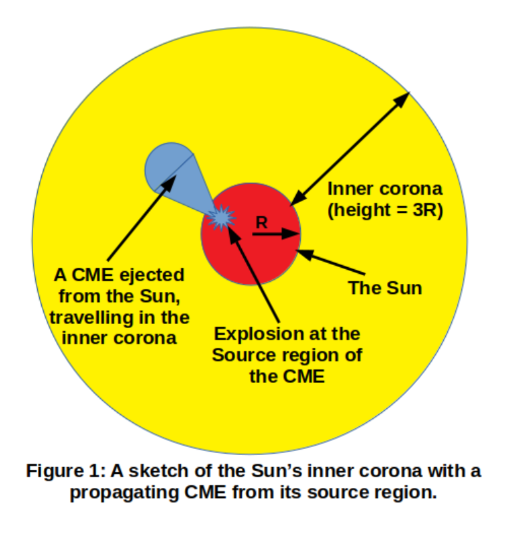
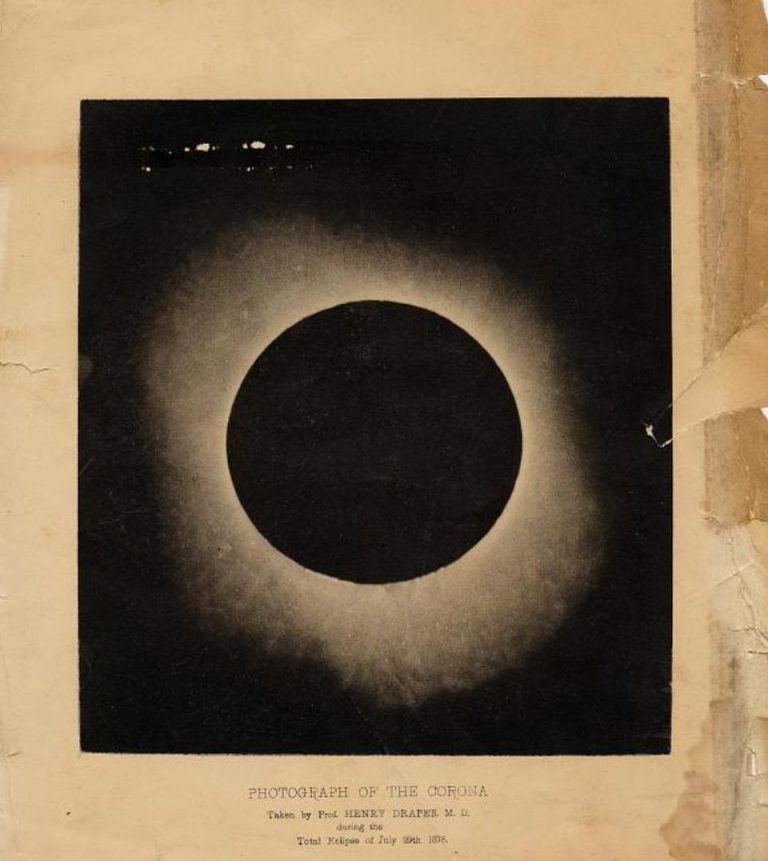
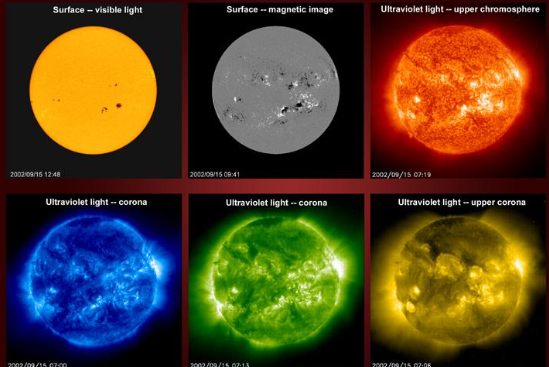
Abhay, the youngest in the room asked, “What is a Coronal Mass Ejection?”, Mani replied, “CMEs as they are referred in short, are large bulb-like structures containing plasma and magnetic field that are ejected from the Sun’s corona (the outermost atmosphere). They are as energetic as a few hundreds of hydrogen bombs put together. The source regions on the Sun, that produce a CME contain high magnetic field strength compared to its surrounding region. A violent explosion in these source regions occurs that results in a CME.” Abhik interrupted, “But why should we bother to study them since they are happening so far away from us?” Mani felt glad for the question. He replied, “You see these CMEs after being ejected, do not remain confined to the Corona of Sun, but they keep travelling into outer space, towards the planets, and in some cases towards Earth too. Although, this is a case of low probability, but with high consequences as such an event would result in severe technological damage, a catastrophe we are not yet ready for. Thus understanding their evolution and propagation, that is their kinematics is of great significance. The two major challenges in this area are the crucial information on kinematics in the inner corona (see Figure 1) and uncertainty due to projection effects. The later term implies that although the actual CME is moving in three dimensional (3D) space, measurements taken from 2D images of the Sun leaves out the information contained in the third dimension. The authors in this paper have thrown light on these areas and have largely improved our current understandings.”
Manibhushan continued, “They selected several CME events that occurred between 2008 and 2014. They used data from several space observatories like the Solar and Heliospheric Observatory (SOHO), the twin Solar Terrestrial Relations Observatory (STEREO) of the National Aeronautics and Space Administration (NASA). First, with a software called Jhelioviewer, they created movies of each event that helped them to connect every CME to their source region on the Sun. The location of the source region gave them a rough estimate of the direction of propagation of the CME. The twin spacecraft STEREO A & B observe the Sun from two different points in space. This double viewpoint provides researchers with a palette of possibilities. The authors took these pairs of images taken at the same time from different positions to recreate the actual 3D structure of the CME by a process known as stereoscopy. This was done with the help of a model called the Graduated Cylindrical Shell (GCS) model. By using this model on successive images taken by the different instruments on STEREO-A/B, they collected several crucial parameters of the CMEs, as they evolved through different heights. Now, that they have all the resources at hand, what awaits is the extraction of information.”
A question from Rajib lifted the curtain of silence, “What did they find then from their analysis ?” Manibhushan replied, “Quite a lot actually. Since you all know that speed is the rate of change of height with time and acceleration is the rate of change of speed with time, from the measurements of different heights travelled by the CMEs at different times, they calculated the corresponding speeds and acceleration of the CMEs at different times. From these calculations, they found that some CMEs showed a sudden very high acceleration phase in their initial part of the motion, after which the acceleration dropped down to almost zero.
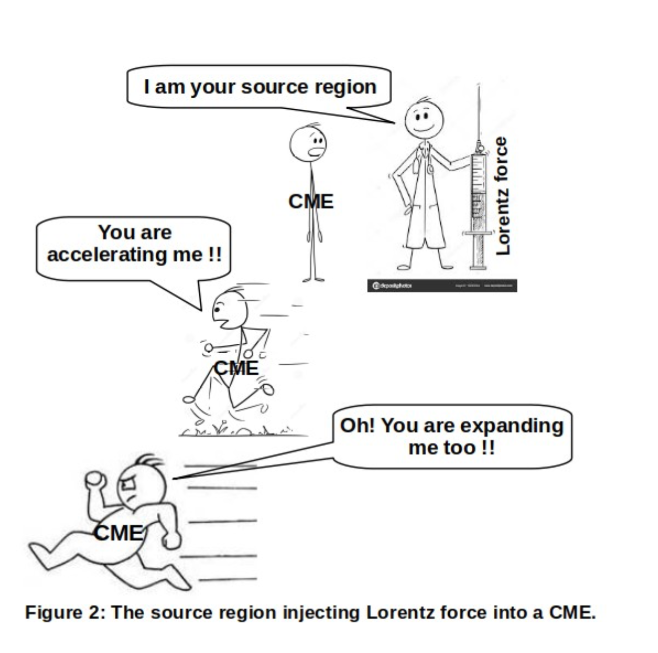
They also found that the CMEs expanded initially as they propagated outwards. This stimulated their minds to note the heights for the CMEs at which their initial high acceleration dropped down and the heights at which the expansion of the CMEs stopped. To their excitement, they found that for most of the CMEs, these two heights were lying in the range of 2.5-3 R (R being the solar radius), which is in the inner corona region. Scientists had earlier shown that it is a force called Lorentz force from the source regions that is responsible for this high acceleration, but from this result, they found something more unifying and fundamental. Since the high acceleration and expansion both ceases around the same height, it vividly shows that it is the same force, that is responsible for this two behaviour of CMEs (Figure 2). In this way, they reported the first observational evidence of the imprint of Lorentz force on the kinematics to stay dominant till a height of 2.5-3 R. Thus this work has unified CME acceleration and expansion as veritable manifestations of the impact of Lorentz force. It will also greatly help in the future, to better understand the mechanism of CME ejection.”
A sense of excitement was sparkling in everyone’s eyes, as Manibhushan continued, “ This is their major result and it is of immense significance to us too. The Indian Space Research Organisation (ISRO) is about to launch its first solar space mission ADITYA-L1 to study the Sun. The authors completely dedicate this result as inputs to the instrument Visible Emission Line Coronagraph (VELC) on ADITYA-L1 which will also observe the inner corona of the Sun. The authors further showed that 2D measurements are often highly misleading, and the correct measurement of speeds in 3D is essential for predicting the time at which the Earth-directed CMEs might reach Earth. They also found that source regions tend to have an impact on the behaviours of CMEs, in a way that the source regions which are highly energetic, drive the CMEs to higher speeds than the ones coming from comparatively weaker source regions. These are all crucial considerations for the correct estimation of the arrival time of CMEs at Earth, because such an encounter has the potential of throwing large parts of the Earth into complete darkness by creating power grid failures, damaging satellites, and posing threat to astronauts in space.”
From the face of his listeners, he understood that he has kindled their minds to ignition and his purpose was met. He concluded “ You see, Physics is not just about black and white, there are grey areas as well, and this paper has beautifully enlightened one such grey area in our understanding. We are homo sapiens, sapiens meaning wise. So, we are the wise ones amongst the different species under homo, who have managed to evolve and become better with time. Let us keep that in mind until we meet next time !”
(This article is a winner of the JAI-AWSAR competition 2022.)
About the Author
Satabdwa Majumdar is a Senior Research Fellow at IIA. His areas of interest are Coronal Mass Ejections and Space Weather.