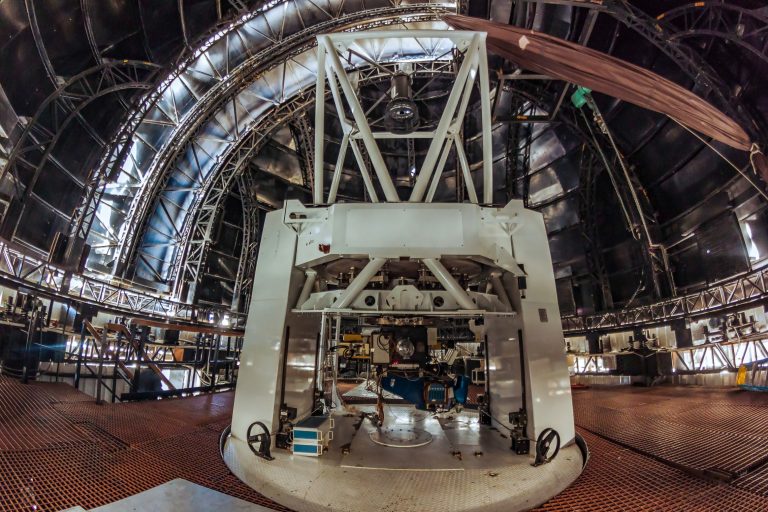
Comet Tales From India
R C Kapoor
Observing comets from India
Although the subject of comets has received space in a few old Indian texts, the description remains confined only to their morphology and the ominous implications. Nowhere is there an allusion as to a specific comet or even a hint that some real-time observations were made.
Since 2009, I have explored records of cometary sightings made from the Indian region, since antiquity until 1960; where available data, however minimal, permits identification of the comet. A few comets that have been dealt with in this series and published are, sequentially, the Great Comet of 1831 (C/1831 A1), Comet Bappu–Bok–Newkirk 1949 IV, the bright comet of 1941 (C/1941 B2), the bright comet of 1825 IV (C/1825 N1), Donati’s Comet (C/1858 L1), the Great Comet of 1807 (C/1807 R1), the Great Comet of 1811 (C/1811 F1), and the Great September Comet of 1882 (C/1882 R1).
A few discoveries too
The first thing that I discovered in this journey was the fact that Comet Bappu–Bok–Newkirk 1949 IV remains the only one with an Indian’s name to it. Then a research student at Harvard, M K Vainu Bappu (1927–82) was destined to set modern astronomy in India on an ambitious path to progress. Is that all? That was my question, but I found the scene less disappointing than it seemed at first. The quest, at best a preliminary, has enabled me to bring forth a number of interesting but hitherto lesser-known or unknown observations of comets from India. These include a handful of discoveries too.
Mughal memoirs mention several astronomical phenomena, namely, fireballs and comets, and the occurrence of a number of solar and lunar eclipses. Abū’l Faḍl and Ārif Qandahārī have narrated their observations of a comet seen in the 22nd year of the reign of the Mughal Emperor Akbar, in 1577. Abū’l Faḍl recorded his observations of the comet in the Akbarnāmā, made during an expedition of Akbar from Rajasthan to Punjab. Ārif Qandahārī, in his account in Tārikh-i Akbar Shāhī, describes the comet as a bright star in the west. Both the accounts are about the celebrated comet of 1577 (C/1577 V1), that was first sighted in Peru on 2 November at dusk as a very bright object that ‘shone through clouds like the Moon (–7 mag)’ and which Abū’l Faḍl and Qandahārī are among the first very few to have independently witnessed on 5 November and 6 November 1577 (Julian) respectively, and entered their impressions in their records.
Tycho Brahe’s observations of this comet were a milestone in the history of astronomy when he placed it in a supra-lunar position. This challenged the Aristotelian perception that comets were atmospheric phenomena. We find Emperor Jehangir as an independent discoverer of two bright comets in succession: the comet 1618 III (C/1618 V1) on the morning of 10 November and the comet 1618 II (C/1618 W1) on the morning of 26 November, going by the corresponding chronological entries in his memoirs Tūzuk-i-Jahangīri.
Scattered among the Madras Observatory correspondence and its publications of the 19th century are observations of some comets, brief but duly reported. Many of these did not receive attention up till now for reasons of lack of access or limited circulation. While sifting through a few scientific communications, I came across observations that can be termed as discoveries only. So, may the due credits be given to – Jeremiah Shakerley as among the earliest observers of and, more likely, being an independent discoverer of the comet C/1652 Y1 from Surat, to Jesuit Fr Jean Richaud as an independent discoverer of the comet C/1689 X1 from Pondicherry, to Ali al Husayani for the discovery of the comet C/1742 C1 probably from Burhanpur and to T G Taylor at Madras Observatory as an independent discoverer of the Great Comet of 1831 on Jan 7.0097 UT, credited to John Herapath alone who discovered it on 1831 Jan 7.25 UT. As I gathered from cometographies, there are also a few independent discoveries made from India – of the comet C/1695 U1 from Surat on 30 October by a French Jesuit Joachim Bouvet, of the comet C/1839 X1 discovered by J G Galle and independently by T G Taylor, and, the Comet 1872 I (X/1872 X1), discovered by Norman Pogson at Madras on 2 December, that was also called Klinkerfues–Pogson Comet by K C Bruhns, who reasoned not to identify it with the lost Biela’s Comet.
John Warren’s unpublished work
This note is about how John Warren’s work on the Great Comets of 1807 and 1811, published only recently, saw the light of the day.
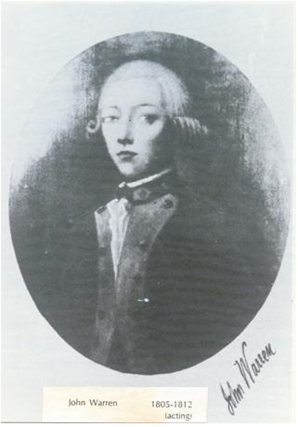
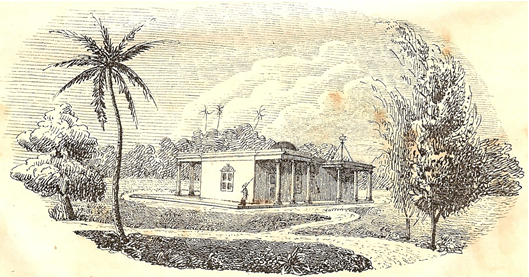
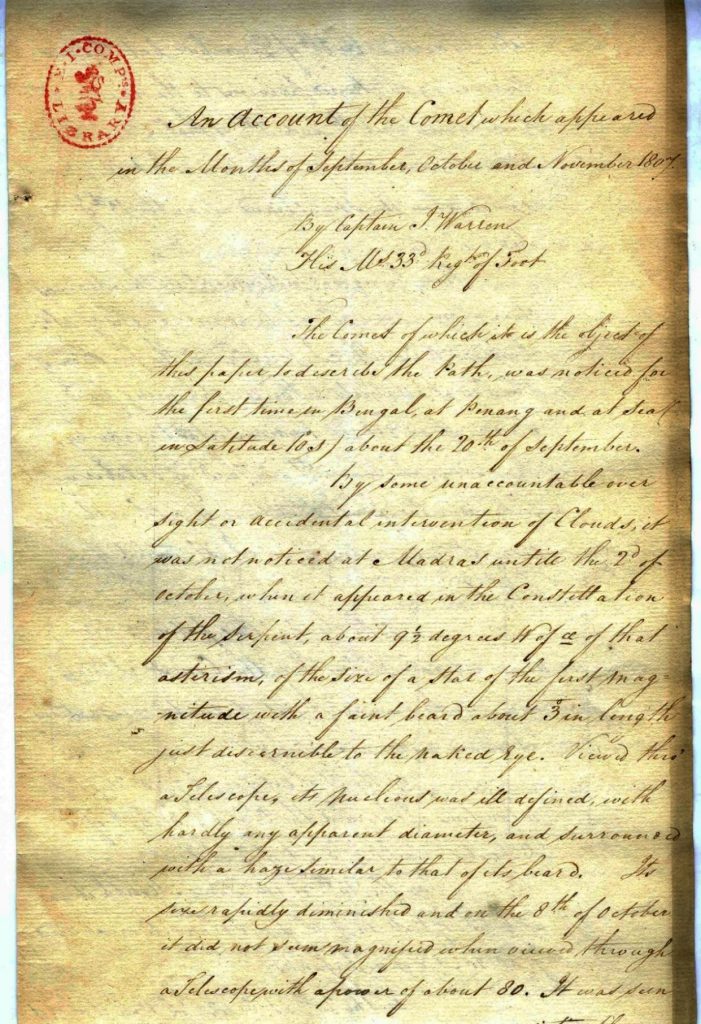
Captain John Warren (Figure 1; 1769‒1830) was the acting astronomer at Madras Observatory during the years 1805‒1811 when Astronomer John Goldingham went to England on leave. For details of the history of Madras Observatory and development of modern astronomy in India, see Kochhar and Orchiston (2017). Warren had observed the Great Comet that rose in September of 1807 (C/1807 R1) and computed its orbit. He summed up his observations in a paper titled ―An account of the comet, which appeared in the months of September, October and November 1807 and sent it to England. The addressee is not known. The paper was a hand-written manuscript with four drawings, dated 1 January 1808. It is now in the Royal Astronomical Society Archives, London (RAS MSS Madras 6). The paper (Warren 1808) remained unpublished.
I came to know of it in 2009 from a paper on Madras Observatory by Ananthasubramaniam (1991), when I had begun to collect information on comet observations made from India. I followed up and traced the paper to the Royal Astronomical Society Archives. On request, the RAS kindly sent me the jpeg images of the original manuscript (Figure 3a). I initially wrote a paper on the Great Comet of 1807 with John Warren’s manuscript as the prime source. I showed it to Prof R K Kochhar for his comments. He suggested that Warren’s paper itself should be brought to light and that my own notes can follow it. I then approached the Royal Astronomical Society for permission to have it published in a suitable journal. The RAS readily agreed and gave me formal permission. Much help in this regard came from Dr Sian Prosser, librarian and archivist, RAS. I transcribed the text from the 21 jpeg images of the original manuscript. Dr Prosser went through the transcription and provided some of the lines missed in the jpeg images. When approached, Prof Wayne Orchiston, Editor, Journal of Astronomical History and Heritage expressed keen interest to publish it. He too went through the transcribed text carefully. The paper has now been published under John Warren’s authorship, with Madras Observatory, Madras as the affiliation (Figure 3b) in the Journal of Astronomical History and Heritage, vide Warren (1808/2019).
The first decade of the 19th century witnessed the most crucial development in the art of orbit computations, spurred on by the discovery of four minor planets between 1 January 1801 and 29 March 1807. The whole exercise of orbit determination used to be arduous. One would divide the orbit into degrees, and for each degree, the computations were performed. The task was daunting. Then in 1801, Carl Gauss (1777‒1855) presented a simple and quicker method of computing an elliptical orbit by using observations derived from an arc in the sky (Gauss, 1809). This approach soon led to the recovery of a lost Ceres. As for the Great Comet of 1807, a number of astronomers, including Friedrich Bessel (1784‒1846), worked out their methods and calculated parabolic orbits based on observations made in October 1807 and incorporating the effects of perturbations. These led to different dates for the perihelion passage. Notably, Warren (1808) had determined the orbit of the comet using spherical trigonometry and Kepler’s laws. The orbital elements are quite close to Bessel’s 1810 values, the latter determined from a much larger set of observations and including the effects of perturbations. Warren’s values differed slightly in the time of the perihelion passage and in the eccentricity value (e) as he regarded the orbit as a parabola. His paper is worth a read by anyone interested in the history of the art of computing the orbits of celestial bodies.
Subsequently, Warren observed the Great Comet of 1811 (C/1811 F1) and recorded his observations in the Madras MS Records for the year 1812. For anyone outside Europe, Warren’s Head Assistant Sanevasa Chairy was the first to independently notice in the sky the Great Comet-to-be from Madras Observatory, after rightfully sensing that the faint nebulosity near a star in Monoceros was a comet. He was well versed with the night sky and celestial phenomena, and prescient enough to perceive the observed nebulous form as a comet. We can only guess how the observers responded to the language barrier, but what the assistant reported to his superior did earn him credit in the latter’s report.
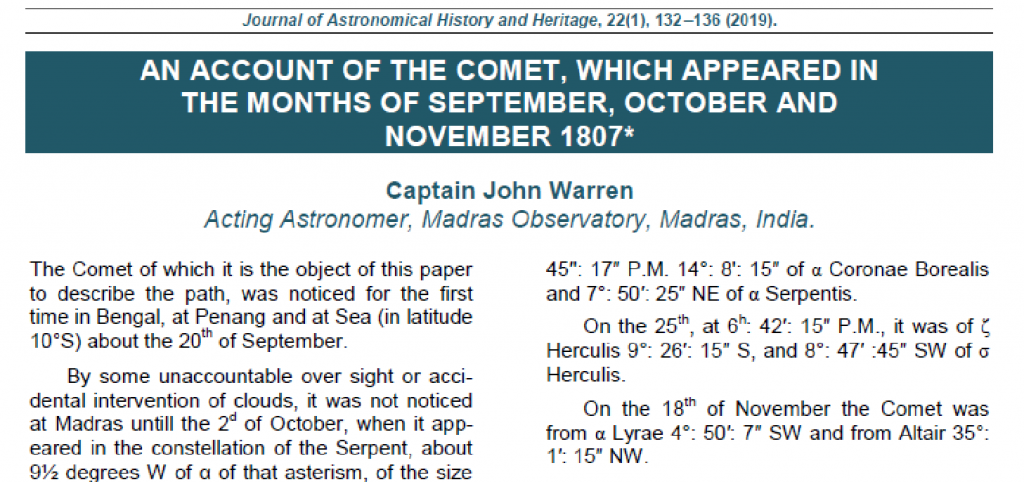

Prompted, perhaps, by the fate of his 1807 paper, Warren chose not to write a paper about Madras Observatory observations of the comet of 1811. My own notes on the comets of 1807 and 1811 appear in the same issue of the Journal of Astronomical History and Heritage (Kapoor 2019a, 2019b) and discuss Warren’s observations of the Great Comets and also those made by others from the Indian Subcontinent. It has also turned out that the Comet C/1807 R1 was first sighted on 20 September in Bengal, making this an independent discovery from India. Notably, this one was the first comet observed at the Madras Observatory ever since its inception in 1786.
Acknowledgments
I am grateful to the Royal Astronomical Society (RAS) for making available from the RAS Archives scans of John Warren’s unpublished manuscript MSS Madras 6 and for permission for it to be published. RAS Librarian Dr Sian Prosser and Prof W Orchiston were very helpful in cross-checks with the original John Warren manuscript. I thank the Director, Indian Institute of Astrophysics (IIA) for permission to use John Warren’s unpublished accounts of the Great Comets of 1807 and 1811 contained in the Madras MS Records held with the IIA Archives. In my quest for comet observations from India, much help has come from Dr A Vagiswari and Dr Christina Birdie in the search for reference material. Mr B S Mohan, Mr P Prabahar, and the Library Staff have continued to be very helpful.
References
Ananthasubramaniam, C.K., 1991. The Madras Observatory, 1792‒1931. Journal of the Royal Astronomical Society of Canada, 85, 97‒106.
Gauss, C.F., 1809. Theory of the Motion of the Heavenly Bodies Moving about the Sun in Conic Sections. New York, Dover (1963 reprint).
Kapoor, R.C., 2018. Comet tales from India. 1: ancient to medieval. In Sôma, M., and Tanikawa, K. (eds.), Proceedings of the Fifth Symposium, 22-24 March 2018, on “Historical Records of Astronomy and Modern Science.” Tokyo, National Astronomical Observatory of Japan. Pp. 14‒61.
Kapoor, R.C., 2019a. On observations of the Great Comet of 1807 (C/1807 R1) from India, Journal of Astronomical History and Heritage, 22(1), 137-146.
Kapoor, R.C., 2019b. John Warren’s unpublished observations of the Great Comet of 1811 from India, Journal of Astronomical History and Heritage, 22(1), 147-154.
Kochhar, R.K., and Orchiston, W., 2017. The development of modern astronomy and emergence of astrophysics in India. In Nakamura, T., and Orchiston, W. (eds.), The Emergence of Astrophysics in Asia: Opening a New Window on the Universe. Cham (Switzerland), Springer. Pp. 705 ‒770.
Kronk, G. W., 1999. Cometography, A Catalogue of Comets, Volume 1 Ancient–1799, Cambridge: Cambridge University Press.
Taylor, T.G., 1838. Results of Astronomical Observations Made at The Honourable The East India Company’s Observatory at Madras by T G Taylor, Vol. IV. For the Years 1836 and 1837. Madras, Madras Observatory.
Warren, J., 1808/2019. An account of the comet, which appeared in the months of September, October and November 1807, Journal of Astronomical History and Heritage, 22(1), 132-36.
About the author
R C Kapoor was with UPSO (now ARIES) during 1971-74 and with IIA through 1974-2010. He has worked on flare stars, the observational aspects of black holes, white holes and pulsars.