To ‘if’ or to ‘when’ that is the question – understanding our nearest star, the Sun
Satabdwa Majumdar
Man had been living under the mercy of nature from the days of folklore. It was only after the dawn of civilization, that we started taming nature, forgetting the fact that when nature shows its displeasure all of a sudden, we are nothing more than flies in the hands of wanton boys. As the light of scientific thinking dawned upon us, we, instead of taming, started to understand nature, realizing ourselves as a veritable manifestation of the same entity. The Sun has been one of the biggest reasons for the sustenance of life on our planet. We have heard from our school days that the Sun is a blazing ball of fire, it is the reason behind every bright morning that we wake up to, the mystique cycle of seasons that we enjoy. In a nutshell, we can say that the Sun takes care of the ABCs of our life, that we are too busy to care.
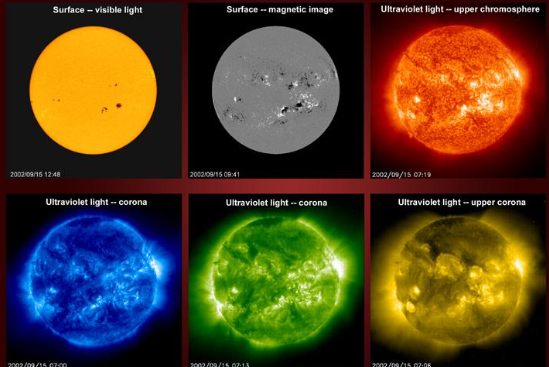
But thanks to the advancement in our scientific understanding that we and the Sun are no longer any cosmic strangers. Given the time, opportunity, and expertise, we have found that the Sun is not just a mere ball of fire, but much more than that. It is neither a solid, nor a liquid or gas, but is made up of the fourth state of matter, which is plasma (a fluid in which the constituent particles are charged). This makes the Sun a sphere of surprises that has been puzzling the minds of scientists all over the world. Just like our Earth has different layers of the atmosphere, so does the Sun. The Solar atmosphere, as we understand is comprised of the photosphere (the term being derived from ancient Greek, with photo meaning light, and thus referring to the spherical surface that emits light), the chromosphere (chromo meaning colour, named due to its reddish appearance around the solar disc during a total solar eclipse), the transition region and the corona (the Latin word for crown, named due to its crown-like appearance around the solar disc during a total solar eclipse.) Out of these layers, the photosphere is the innermost, and the corona is the outermost layer. It is the photosphere (the bright white disc that we see everyday), from which light escapes from the Sun and reaches our eyes, and we are able to see it. As the density of the solar atmosphere decreases with height, the outer atmospheric layers become fainter, which makes it difficult to identify in the presence of the bright photosphere, just like the way it is difficult to discern the glow of a swarm of fireflies around floodlights in a cricket stadium. The Sun generates its energy at its centre through the process of nuclear fusion and is at a temperature of around 15 million Kelvin. This generated energy is transferred by first radiation, and then convection to the atmosphere of the Sun. Convection and radiation are two different modes of transfer of heat from one point to another. The difference in the two can be easily visualized. If you take a ball and throw it to your friend, then neither you, nor your friend moves, yet the ball is transferred from you to your friend. This is the process of radiation. On the other hand, if you are not sure of the catching skills of your friend, you can take the ball and walk up to your friend and hand over the ball to him. In this case, the transfer of the ball required you to move. This is the process of convection. From the centre of the Sun, as one moves out, the temperature decreases. This is what we expect, as we move away from a fireplace, we feel lesser warmth with increasing distance from it. But the Sun defies this strong intuition of ours, and shows a sudden increase in its temperature in its outermost layers, resulting in a coronal temperature of a few millions of Kelvin, while the Photosphere is only at around 6000 K. This is also known as the famous coronal heating problem. Such change of temperature, density and magnetic structure with height is manifested in different looks of the Sun as seen in different wavelengths (see Figure 1).
The Sun has been one of the biggest reasons for the sustenance of life on our planet. We have heard from our school days that the Sun is a blazing ball of fire, it is the reason behind every bright morning that we wake up to, the mystique cycle of seasons that we enjoy.
Along with this, the Sun on its own harvests a magnetic forest in and around itself. And just as every forest has a forest canopy, the magnetic forest of the Sun also has a canopy, with an additional fascination that the structure and appearance of this canopy changes with height. The magnetic field lines which create this magnetic forest are highly dynamic in nature. A set of such densely packed magnetic field lines often form what is known as a flux-tube. These imaginary tubes are highly flexible, and being so, they often get twisted, stretched or sheared. When the magnetic field inside these flux-tubes increases, they are pushed upwards, finally emerging out of the photosphere (but still staying connected to the Sun). These regions through which these tubes emerge out are seen as dark spots on the solar disk (photosphere). They are termed Sunspots. Despite being dark spots, due to very high magnetic field content, they harbour the brightest of events that occur at the Sun. These emerging flux-tubes protrude up to higher heights and thus reach the upper atmospheres. But, as mentioned earlier, the Sun is no solid body, and hence it does not care for the laws that govern the dynamics of any rigid body (say an iron ball). Thus, as the Sun rotates around its own axis, different points on the Sun rotates with different speeds, and hence there is a relative motion between adjacent regions on the surface. As a consequence, the super flexible flux-tubes get twisted, and sheared, and then they become flux-ropes (a structure roughly resembling a twisted towel when we drain out the water from it).
The Sun, apart from being such a sphere of surprises, is also a fascinating cosmic laboratory for astrophysicists, that offers visual evidence of several equations that we find in books, equations which are difficult to carry out in any man-made laboratories.
If you are wondering at these striking and unusual features the Sun shows, then hold on a little more, as the best is always reserved for the last, and I being no Sun, will surely comply with this notion. In our high school physics, we have learnt that two magnetic lines of forces cannot touch each other or intersect. But even that is possible at the Sun’s upper atmospheres, in the corona. It has been observed that when two oppositely directed magnetic field lines come near each other, they get re-connected, and this results in a violent explosion (a solar flare, as Prof. Arnab Raichoudhuri, quotes these as “signs of cosmic illness”, which the Sun tries to get rid of) that produces bright emissions in different wavelength regions of our electromagnetic spectrum (radio, extreme ultraviolet, X-rays, Gamma rays etc). Things don’t stop here too. For very energetic explosions, a part of the mass contained and constrained by the magnetic forest in and around that region is expelled from the Sun at varying high speeds. This ejected magnetic structure is highly energetic as they result from a series of multiple re-connection that releases a huge amount of thermal and electromagnetic energy in a very short span of time. They are called Coronal Mass Ejections (CMEs). These ejected materials travel from the Sun into the outward space, and hence in some cases, towards Earth too. And in such cases, there is a potential chance of another reconnection between the magnetic lines of the CME and the Earth’s own magnetic field lines, which leads to what are known as violent geomagnetic storms that can severely damage our daily life by creating power grid failures, damaging satellites, and posing threat to astronauts in space. And despite the unprecedented advancement in technology, such storms are a catastrophe we are not yet ready for.
So, the situation is twofold. Firstly, ‘IF’ a solar flare occurs, what is the probability of a CME ejecting out of it, and travelling towards Earth? And secondly, ‘IF’ a CME does travel towards Earth, ‘WHEN’ will it reach Earth? It is a situation of low probability, but of high consequences, thus demanding undivided attention. This is a situation where the question “WHEN” surpasses by large the question “IF” for their importance and implications. But we must understand that we don’t look at things as it is, but we look at them as it was, because light (and hence the information) takes a finite time to travel. What we see has already happened and, what might happen in the future is an attempt to answer “WHEN”? As an attempt to answer these IF’s and WHEN’s, there have been several space and ground missions to study the Sun from several countries. India is also getting ready with our first-ever space mission to study the Sun, ADITYA L1. ADITYA L1 will provide us with crucial information that might help us to connect the ‘IF’ to the ‘WHEN’ and possibly unite them to a more profound question ‘WHY’?
The Sun, apart from being such a sphere of surprises, is also a fascinating cosmic laboratory for astrophysicists, that offers visual evidence of several equations that we find in books, equations which are difficult to carry out in any man-made laboratories. To understand nature is the aim of physics, and to understand the Sun and the Sun-Earth connection, is the aim of solar astrophysics. After all, who among us cannot sympathize that we long to be here for a reason, for a broader goal to understand better, the intricate knots that tie the stardust (us) to the star (our Sun), to preserve this ‘pale blue dot’, to realize the universe within us, and most importantly to understand THE SIGNIFICANCE OF THE INSIGNIFICANT US, IN LIVING WITH OUR STAR – THE SUN.
About the author
Satabdwa Majumdar is a Senior Research Fellow at IIA and he works on the kinematics of Coronal Mass Ejections in the inner corona.