Extra Solar planet: The lamp in dark!
Manika SIngla
Eight years ago, innocent Ishu was staring at the stars incessantly on a cold winter night. Her mother was sitting beside her on an old charpai [a bed] and sipping hot badam milk. Ishu’s face was gleaming under the full Moon. She suddenly asked, “Ma! What are stars?”.
Ma smiled and answered,” My Dear, when anyone close to our heart dies, that person becomes a star.”
Another question tickled her heart, “How?”. Ishu continued to believe what Ma used to tell her until she started studying and thinking independently.
Today She thinks that stars are nothing but big balls of fire, just like our Sun. She was baffled to know that our Sun is also a star that is very close to us compared to other stars. But it is far enough that even light takes eight minutes to reach from Sun to us. There are many types of fireballs in space. Some are big; some are small! The smallest one is still bigger than our Earth. Some are hot, and some are cold! The coldest one is still hotter than whatever you can imagine as the hottest thing in the world!
Those stars also have planets around them, just like our Solar system. And they are known as extra-solar planets or exoplanets. Ishu could not believe the possibility that people like us also live on some other planets around some fireball other than our Sun.
She tells all this to her mother. Ma is astonished! Ma speaks angrily,” I don’t believe all this! Who teaches you all this rubbish?”. This time her mother asks, “How? How can you say it so confidently?”.
Ishu replies,” Ma! When a planet revolves around a star, it will come in front of the star at a specific time. At that moment, Scientists observe lesser brightness of the star as the planet blocks some part of the star. We cannot see this through naked eyes because it is very far away from us. It is the same as the solar eclipse when Moon blocks some part of the Sun.” She enthusiastically added,” Imagine a fly moves in front of a lighthouse, and it is about 15 km far from us. See! How difficult it is to detect an extra-solar planet.”
Ma gets interested in all this and says with gratefulness,” We are blessed that we have Oxygen to breathe, water to drink, food to eat, and shelter to sleep!”. “Do other planets also
offer such luxuries?”, She asks. “Maybe!”, Ishu replies. Ma curiously asks, “How do we get to know about that?”. Ishu excitedly goes and comes back with a torch in her hand and two transparent pens full of blue ink. She fills water in one of the pens by opening the upper part of the pen and ensuring water does not leak. She moves the first pen (without water) in front of the torchlight. She says, “Some of the light is blocked by the pen’s refill. But we can’t see it as it blocks very little.” Now, she brings the second pen in front of the torchlight. She says, “Besides the blockage of light by the refill, some part of the light is eaten up by the water. Or I should say, water absorbs some of the light. Like water envelops the refill of the second pen, the atmosphere surrounds an almost spherical-shaped planet. That atmosphere can contain several gases, water, water vapors, etc. And that atmosphere absorbs some of the star-light, and the remaining gets transmitted and reflected. “.
“Wow! That’s wonderful, Ishu! Tell me more! How do we know which gas is present in the planet’s atmosphere? That absorption in the light can be due to any gas. Isn’t it?” Ma asked eagerly. Ishu exclaimed,” That’s a pretty thoughtful question, Ma!”. She added,” Light is composed of several parts. One is the visible part (white light) which we can see. It is composed of seven colors”.
“Seven colors! What are you saying?” “Yes, Ma!”
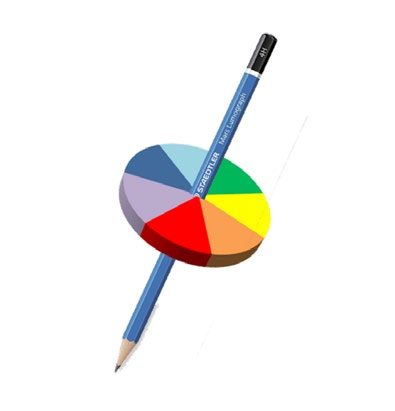
Ishu makes a disc out of some white cardboard, paints it with seven colors, and inserts a pencil in the center, as shown in the picture. As soon as she starts rotating the pencil, Ma gets surprised to see such a clear white disc. For a few moments, both get lost in the tranquil white color. After a while, Ishu says,” Violet part of the light is the most energetic while red has the least energy.”
Ma asks,” Tell me about the other parts of the light. Why is light made of several elements?”. Ishu: “Light is made of different-different energy packets. The light which has lesser energy than visible is known as infrared. It lies just below the red region. The ultraviolet region lies just above the violet light, which means more energetic than visible.”
Ma: “Why are you telling all this? Is this anyhow related to the absorption of light by different gases?”
Ishu says,” Yes! Different gases absorb light of different energies. Also, they absorb different amounts of light. These absorptions behave as the fingerprints of the gases.” Ma tries to understand and complete,” The light we obtain while sitting on Earth contains all these
features. So we can tell which gas is present in the planetary atmosphere and in what amount.” Ishu nods her head with a beautiful smile on her glowy face. Both enjoy a few moments of silence.
Ishu is overflowing with knowledge. She suddenly starts saying that the planet should also reflect some starlight when it moves around the star. She asks herself,” How do we account for that?”. Ma starts thinking again! Ishu immediately makes her Ma stand in front of a mirror with a torchlight pointing towards the mirror. And the light is shining brightly directly on her dusky face. Ishu pushes her mother gently towards the right side of the mirror so that Ma can not see herself in the mirror. And she stands on the left side of the mirror. Ma again points the torch towards the mirror. This time Ishu gets enlightened by the light, and her face is gleaming with joy.
Ishu tells Ma that this is almost the same case for the star’s light reflected from the planet. She adds that the only difference is that the light gets reflected in other directions because the surface of the planet is not exactly like a smooth and polished mirror. This type of reflection is known as scattering.
She further says, “We see only some part of the scattered light coming in our direction. Also, not only the surface but the atmosphere also scatters.”
Ma: “How atmosphere is responsible for that?”
Ishu: “Ma! The atmosphere contains gases and dust particles. They become obstacles in the path of light and make the light move in other directions as well.”
Ma: “Is this phenomenon the same for all the parts of light?”
Ishu: “No! Just like absorption, different amounts of scattering take place for different parts of the light. The more energetic the light is, the more the scattering is! This is known as Rayleigh scattering, named after its discoverer, Lord Rayleigh.”
She asks,” Which part of the light can scientists see in the reflected light?”. Ma ponders for a few minutes. Ishu interrupts and says, “ The most energetic light is present in more amount whereas least energetic light in the least amount. The amount of the reflected light also depends on the starlight that is incident on the planet before reflection.”
Ma feels empathetic towards her and says in a nutshell,” The reflected Light that scientists observe is composed of scattering, absorption, and the incident starlight.”
Ishu took a deep breath and said with a proud face, “You are absolutely right! There may be other things also which I also don’t know now. That’s research Ma! Some scientists will come up with other things, and the theory will become more and more accurate. That’s the joy of
research! We should never stop thinking and imagining.” Ma got illuminated, and the darkness of superstition flew away. They both slept peacefully, holding each other in their arms on that old charpai, and started dreaming on the cold winter night.
(This article is a winner of the JAI-AWSAR competition 2022.)
About the author
Manika Singla is a Senior Research Fellow at IIA. Her research area is the atmospheric modeling of the terrestrial exoplanets and currently she is working on the reflection and the transmission spectra of the present and early Earth-like exoplanets.