A Tale of Two Eclipses
Sarthak Choudhary
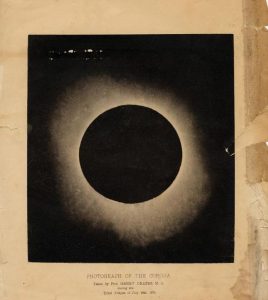
On July 29th 1878, residents of Rawlins, USA were ready with their smoked glass to witness a spectacular show of the celestial hide and seek – a total solar eclipse. Astronomers from all over the world had already arrived in the town. Amongst those was a party of astronomers led by Henry Draper and accompanied by inventor Thomas Edison who had already set up a temporary observatory for this day. But what was the purpose of their visit? Henry Draper was a famed astrophotographer, he wanted to photograph the corona of Sun, and left all the scientific data gathering to his colleagues. Thomas Edison wanted to test his new invention, ‘tasimeter’ to measure small changes in ambient temperature during the eclipse. The scientific motivation for the party to travel all the way to Rawlins enduring dust storms on their way was to look for the signs of a planet between Sun and Mercury. Astronomer and mathematician Urbain Le Verrier had predicted a hidden planet to be the cause for the orbital precession of the perihelion of Mercury. Urbain had previously predicted the existence of an eighth planet beyond the orbit of Uranus which proved to be correct. The planet Neptune was the first planet whose existence was predicted before it was ever observed by a telescope. Could there be another one, an entire planet lurking between Sun and Mercury? Astronomers of the day had even named the unfound planet- ‘Vulcan’ after the Roman God of fire, not the homeworld of science officer Spock. The expedition wasn’t particularly successful, the astronomers couldn’t convince the astronomy community that they had sited Vulcan and Edison’s equipment proved to be too sensitive to measure the temperature variations caused by the eclipse. However, Draper did manage to photograph corona. The irregular orbit of Mercury was later explained by Josef Lense and Hans Thirring using Albert Einstein’s General Relativity (GR).
Eddington wanted to verify Einstein’s theory which says that gravity is the manifestation of curvature of space-time caused by a massive body.
In 1919, an astronomer by the name of Sir Arthur Stanley Eddington would reach Príncipe off the coast of West Africa as a part of another expedition to catch the glimpse of an eclipse. This time the goal wasn’t to find an unseen planet but rather improve our understanding of the cosmos. General relativity had challenged the prevailing theory on gravitation formulated by Sir Isaac Newton which was thought to be working well at the time. Eddington wanted to verify Einstein’s theory which says that gravity is the manifestation of curvature of space-time caused by a massive body. To check this, Eddington and astronomer Frank Watson Dyson had designed an experiment where Sun, Moon and other stars were the apparatus. To prove that a massive body such as our Sun indeed can cause space-time distortions, one needs to observe a star, once when it is close to the Sun and once when it isn’t. No stars are seen in the daytime, hence one must wait for a total solar eclipse. During a total solar eclipse, the sky turns dark albeit for a very small period. For the eclipse of 29th May 1919, the totality lasted for a little under 7 minutes. It was during these seven minutes that the astronomers had to capture the precise location of preselected stars in the sky. When the photographic plates were analyzed from both the expeditions and the results of the shifts in the star positions were computed, the results matched with the GR predictions to a very high degree of accuracy. The success of the expedition came in the form of observational proof of general relativity which catapulted Einstein into an international figure.
Fun fact 1: Both of the phenomena which motivated these expeditions were explained by the same theory.
Fun fact 2: The founder of prestigious journals Science (Thomas Edison) and Nature (Norman Lockyer) participated in the expedition of 1878 eclipse.
About the author
Sarthak Choudhary is a Junior Research Fellow at Indian Institute of Astrophysics. When space and time permit he likes to write about history of science.