Thirty Meter Telescope and its First light instrument – WFOS
Ramya and Sivarani
The next decade of astronomy will be led by the discoveries from the upcoming large telescopes, such as the Thirty Meter Telescope (TMT). TMT will take images and spectra of the faintest and farthest objects in the Universe and will deliver an unprecedented view of the Universe to humankind. TMT is a Ritchey-Chrétien telescope with a 30 meter primary (M1), which consists of 492 hexagonal mirror segments of size 1.44m. These mirror segments are supported by a segment support assembly (SSA), which will tip, tilt and also warp the mirror segments to compensate for figuring errors and actively controlled during observations to compensate for varying environmental conditions and produce the sharpest images of the sky. The sensitivity of the telescope scales with the area of the primary mirror, for seeing limited observations. However, in the case of diffraction-limited performance of the telescope, the sensitivity scales as the square of the area of the primary mirror. TMT has one of the most advanced multi-conjugate adaptive optics systems (deformable mirrors conjugated at 0km and 11.8km height of the atmosphere) to achieve diffraction-limited performance over a large field of view. TMT is being built as a partnership between Canada, China, Caltech, University of California, Japan and India. The most attractive feature of TMT is the scalable segmented mirror and adaptive optics techniques. The partnership allows a larger in-kind contribution that will enhance training in science and technology beneficial for India. India is a 10% partner in this massive ~2 billion USD project and a significant portion (~70%) will be delivered through in-kind contributions.
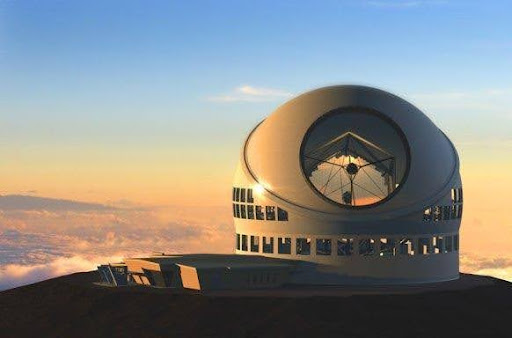
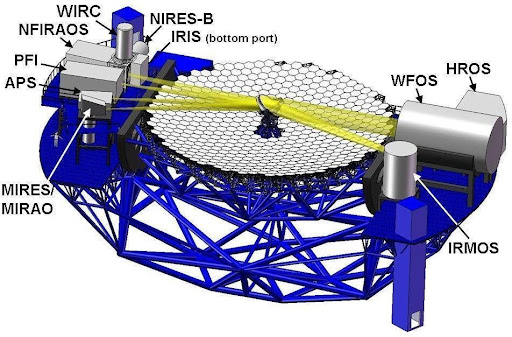
Rendering of TMT Telescope Enclosure and suite of science instruments on the Nasmyth platform. NFIRAOS, IRIS, WFOS and MODHIS (not shown in picture) form the first light instruments of TMT.
India’s Contributions:
India will polish 86 of the primary mirror segments at ITOFF, CREST Campus, Hosakote. These mirrors have to be polished to an accuracy of (1-micron peak-to-valley) and will be cut into hexagonal segments. Rest of the 492 segments will be made across the partner countries. The final surface figure each of these mirror segments should achieve after ion beam figuring is ~2nm. The entire segmented mirror assembly will function as a monolithic 30-meter mirror using the actively controlled M1 control system. The M1 control system (M1CS) consists of individual SSA that provides stable support of M1 segments without causing distortion, and a large number of Actuators (1476) and Edge sensors (2772) will provide sensing and active control of the entire SSA assembly. Another major Indian contribution is in the development of Observatory Control Software and the Telescope Control Software of TMT. India is also making significant contributions to the design and development of one of the first-light instruments, the wide-field optical spectrometer (WFOS) and will lead the development of one of the 2nd generation instruments – the high-resolution optical spectrograph (HROS). Details about each of the contributions will be presented in subsequent issues of DOOT. Other first light instruments other than WFOS are NFIRAOS, the adaptive optics facility of TMT which will feed the light to IRIS – InfraRed Imaging Spectrometer and MODHIS, a high-resolution IR spectrograph.
WFOS – First light instrument: Design Phase
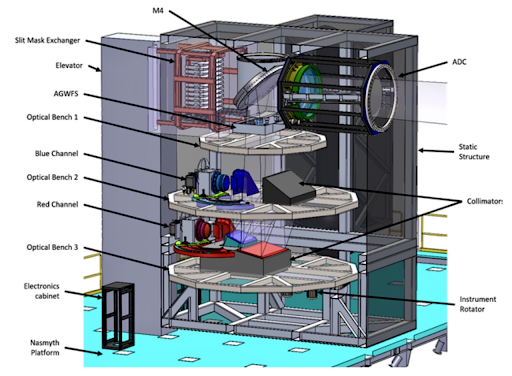
In this issue of DOOT, details about WFOS are presented. WFOS is a versatile work-horse instrument of TMT capable of direct imaging, long single-slit spectroscopy and multi-slit spectroscopy of the entire optical wavelengths. These can be performed at different spectral resolution modes, R~1500, 3500 and 5000, through various gratings and slit widths. The field of view of WFOS is 8.3×3 arcminutes. The corresponding physical size is about (~1×0.4) m. Hence the instrument is huge, similar to the size of a 2m telescope. The light from the telescope’s Nasmyth focus is corrected for atmospheric dispersion, as the atmosphere of earth itself disperses the light like a prism. The dispersion could be of the order of several millimetres. WFOS corrects the atmospheric dispersion using a pair of prisms of 1.3 m size that moves linearly to correct the dispersion caused by the atmosphere. WFOS uses novel aspheric dual collimators, and a dichroic mirror separates the light into blue and red channels with the split around 550 nm, that feeds the blue and red spectrographs. Each of the spectrographs has a number of filters/gratings to optimise the performance and facilitate the broad science goals of TMT. The camera, cryostat and detector assemblies are also optimised for the wavelength range of the spectrograph to maximise the efficiency. WFOS also has a guiding and wavefront sensing system to facilitate guiding and active wavefront sensing during observations.
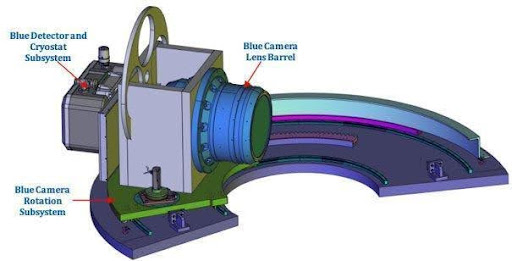
Some of the key science goals of WFOS will be to study the intergalactic medium, galaxy formation and evolution, dark matter, chemical evolution of the local group and exoplanets. It is hard to speculate about the exciting science cases of the next decade. Hence, WFOS has several observing modes with maximum flexibility to enhance the discovery of space for future astronomy.
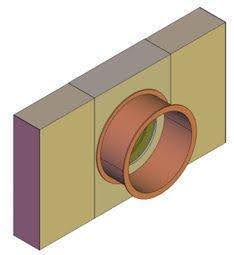
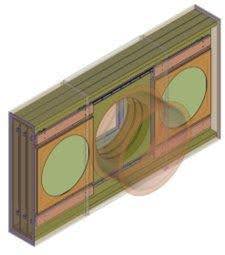

The WFOS team successfully passed the interim conceptual design review in May 2020, which was attended by over 30 scientists and engineers from across partner countries. WFOS is expected to observe the faintest objects and obtain extremely sensitive spectroscopic data either through first-hand observations or via deep followup of some of the exciting events in the Universe.
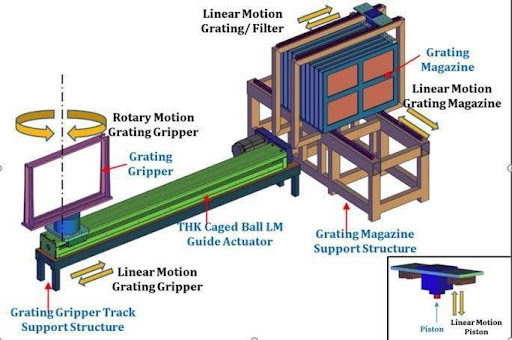
India’s contribution to the design of WFOS is significant. The India-TMT team contributes to five major subsystems of WFOS: Mechanical design of Grating Exchange system (GRX), Camera Rotation system (CRS) and Filter Exchange system (FRX), optomechanical design of the Calibration system (CAL) and design and development of the Instrument Control Software (SWE). The close involvement of India-TMT team in science instruments will enable us to understand the complexity of instruments and aid us in successfully calibrating the data to maximise the science returns from the instrument for the future astronomy community in India.
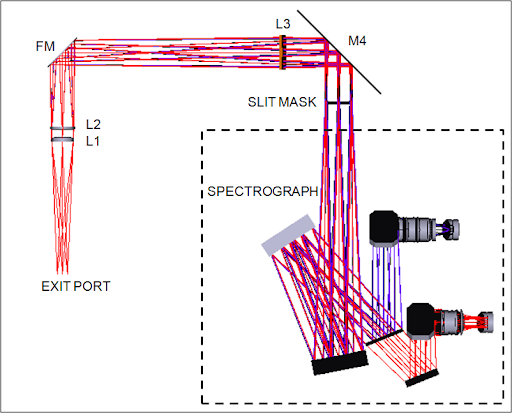
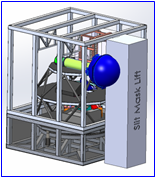
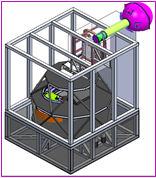
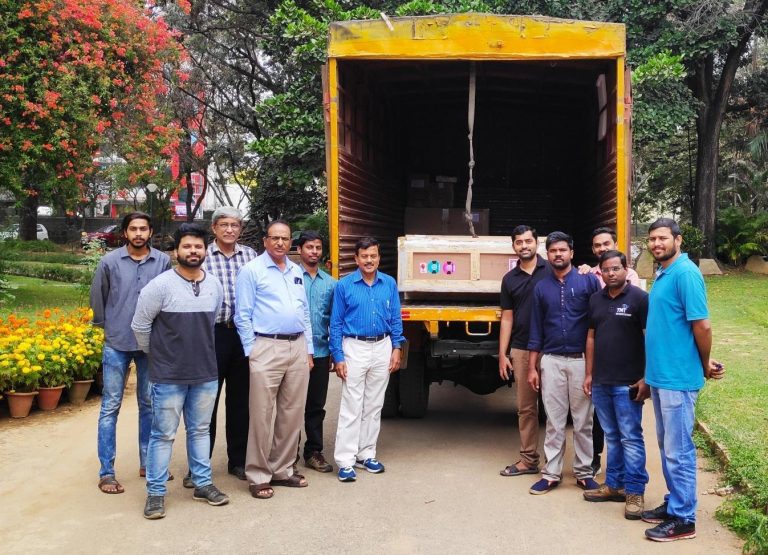
place the 2m Integrating Sphere
(To be continued…)
WFOS-India core team: Devika Divakara, K. V. Govinda, Harimohan Varshaney, T. S. Kumar (ARIES), S. Ramya, T. Sivarani, S. Sriram, K. Sudharsan, N. Viswanatha
About the authors
Ramya Sethuram is a Project Scientist at India-TMT, IIA. Her research interests include galaxy formation and evolution of dwarf galaxies, low surface brightness galaxies, star formation studies in galaxies and astronomical instrumentation.
Sivarani Thirupathi is a professor at IIA. Her research interests are stellar archeology with metal poor stars, exoplanet host stars and astronomical instrumentation.