Detection of a dead companion to a Vampire star in the Globular Cluster of our Galaxy
Snehalata Sahu
Have you ever heard of a vampire-like star existing in our Universe? If not, then you are missing the story of one of the most exciting types of stars, known as “Blue Straggler Stars” (BSSs). They are called so because they appear blue in color and straggle or lag in age behind their ancient neighbors, which are already evolved off and dead now. These stars were silently hiding in a spherical house consisting of only old stars, known as Globular Clusters (GCs), before they were first discovered in 1953. The discovery of BSSs led the astronomers to concern how come such an old age home i.e., GC, harbor these young BSSs? Given their mass (1.2-1.4 times the mass of the Sun) and the current age of the cluster (10-13 billion years), these stars should have been dead now, unlike the other low-mass old stars which still have enough food to survive i.e., hydrogen fuel to burn. It suggests that the BSSs somehow managed to get the extra food (hydrogen) to remain young and prevent themselves from dying soon. After monitoring these stars with Space and ground telescopes, the astronomers found observational evidence that some of these stars are not single; rather, they exist in binaries. These results revealed that the BSSs might have gained the extra fuel by sucking mass from their companion star. This phenomenon is analogous to a vampire-like event, hence these types of stars are called the Vampire-like stars.
Here’s the story of how our team at the Indian Institute of Astrophysics Bengaluru has caught one such vampire star with its dead companion hiding in Globular Cluster NGC 5466, which is located in our galaxy in the constellation Boötes. This work was done in collaboration with a group of foreign scientists in Canada and the USA.
To look for the vampire stars, we first need to identify the possible candidates from the millions of old stars present in the house. GC house contains a large population of cool stars such as red giants (as they are large and appear red in visible color), which are bright in optical wavelengths outshining the young BSSs. Thus, identifying the BSSs in Globular clusters is not an easy task. It is just like counting a bunch of fireflies (BSSs) with a huge light bulb (red giant stars) in front. The brightness of a light bulb dominates over that of the fireflies, making it difficult to distinguish the fireflies from the light bulb appropriately. Thus, to identify the fireflies, we must switch off the light bulb. Similarly, to detect the BSSs, we need to switch from the optical to Ultra-Violet (UV) wavelengths, as BSSs are brighter in UV.
“Our study provides the observational evidence of a vampire star caught with a dead companion in a binary system in the outskirts of cluster NGC 5466 using the Indian UV Space Telescope.”
Generally, astronomers use filters mounted on the detectors in the telescopes to study the properties of stars. The advantage of a filter is that it allows the light of a particular wavelength band to pass through, and bypass the rest. It is similar to a tea filter that separates the tea leaves from the water. UV filters suit best to identify the BSSs and other hot stars. We are aware that the UV observations cannot be carried out through ground telescopes because Earth’s atmosphere blocks the UV light. Thus, to observe in UV filters, we need to put our telescopes in space above the Earth’s atmosphere. We took the observations of the cluster using Ultraviolet Imaging Telescope (UVIT) onboard AstroSat, India’s first multi-wavelength space observatory, launched on 28 September 2015 by Indian Space Research Organization (ISRO).
With the help of the UVIT data, we have identified the possible BSS candidates in the Far-UV (< 2000 Angstrom) filters in the cluster NGC 5466 and checked whether they are the real members of the old GC house or not. One of the criteria for being the actual member of this ancient family is that they should all move together in space. The true members were selected using the data from the Gaia spacecraft of European Southern Observatory (ESO) that consistently tracks the motions of these stars in space for years. It is the first time we have observed these stars in the Far-UV domain and identified 14 BSS members.
If we approximate stars as black bodies, the physical parameters of a star, such as effective temperature and radius, remain hidden in its spectrum. Therefore, we have obtained the spectrum of one BSS candidate, NH 84 (named after the first discoverer: Nemec and Harris) located in the outskirts of the cluster using Gemini multi-object spectrograph mounted on Gemini North Telescope in Hawaii, USA. We were unable to obtain the spectra of the rest of the BSSs as the telescope cannot resolve these stars, which lie in the crowded regions near the center of the spherical house.
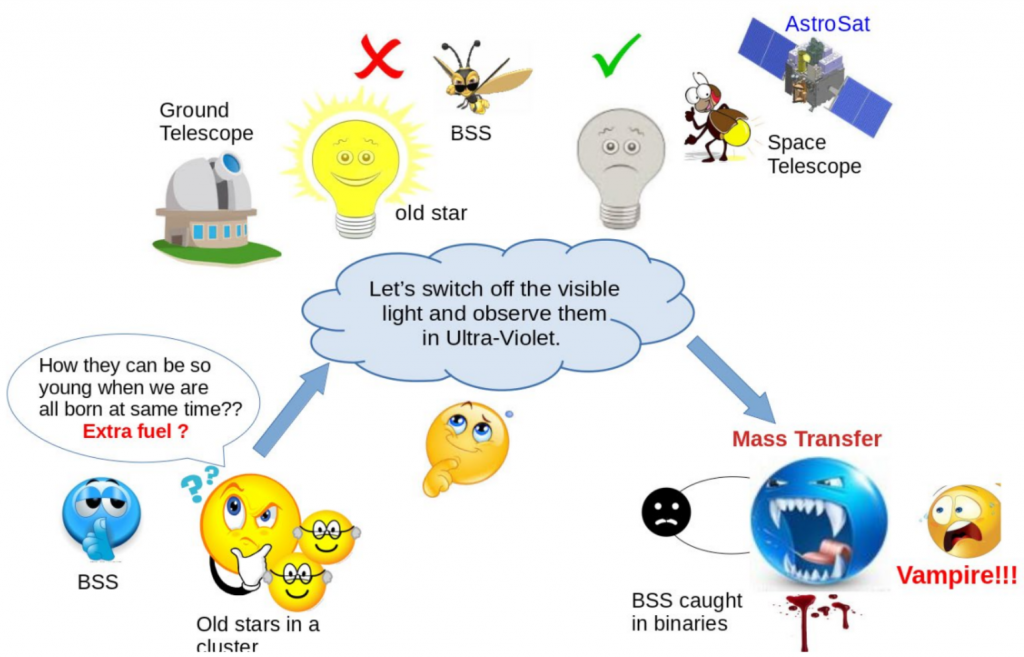
By spectrum analysis, we found the radius of the BSS NH 84 to be 1.44 times the solar radius, and the temperature around 8000 Kelvin (K). This suggests that the BSS is hotter than the Sun with peak emission lying at the bluer side of visible wavelengths. Its behavior in UV is unknown as the obtained spectrum covers only the visible and near-infrared part of the total radiation emitted by the BSS. Exploring the UV region can provide essential clues about the nature of the BSS. The idea is straightforward. If the BSS is a single star, its emission in the entire wavelength range of the spectrum, including the UV wavelengths, should match with a star of temperature 8000 K. If it didn’t, then there are other mechanisms contributing to the UV emission causing a deviation. Thus, to sample the UV region of the spectrum, we took the help of the UV observations carried out in four UV filters of UVIT. Checking the slope of the spectrum in the UV region, we found that the BSS shows excess emission in the UV wavelength region, which is not expected from a single star of temperature 8000 K. Further analysis suggested that the excess UV emission can be explained by invoking the presence of a hot companion. The hot companion’s temperature was 32000 K, which is five times the solar photosphere temperature, and the radius is around 2 percent of that of the Sun. It suggests that the companion is a white dwarf (WD). They are called so because they appear white and are small in size. The WDs are the end stages of the evolution of stars having specific mass. They don’t have enough mass to undergo further nuclear fusion and are thus dead. They can’t be detected easily as they are extremely faint in visible wavelengths. But being hotter, their peak emission lies in Far UV wavelengths. We illustrate the result in the cartoon below.
Our study provides the observational evidence of a vampire star caught with a dead companion in a binary system in the outskirts of cluster NGC 5466 using the Indian UV Space Telescope. The UV observations have helped in finding the reason behind the early death of the companion star. In the past, the BSS was like an old member of the GC house, but later it underwent mass transfer from a giant companion, appearing younger and more massive in the present state. UV study of more such BSSs in the future can provide a better understanding of their formation mechanisms in the clusters. The results are published in the Astrophysical Journal (Sahu et al. 2019).
About the author
Snehalata Sahu is a Post doctoral Researcher at IIA. She works on stellar populations in globular clusters.