Zeeman Effect
Raveena Khan
The Zeeman effect was first discovered by the Dutch physicist Pieter Zeeman in 1896 when he placed the flame of a Bunsen burner between the poles of an electromagnet and held a piece of asbestos covered with common salt in the flame. After the electromagnet was turned on, he observed that the two D-lines of the sodium spectrum were clearly widened. He thought that this broadening of the spectral lines might be due to an increase in the density or temperature of the flame. He repeated the experiment with other sources by eliminating density or temperature variations, but he observed the same widening of the spectral lines. He was finally convinced that it was the effect of the magnetic field that affected the light radiated by the flame and resulted in the widening or splitting of the sodium lines. H.A. Lorentz, who was Zeeman’s mentor as well as collaborator, developed a theory of electromagnetic phenomena that clearly explained the emission of light in this way. Thus, it was the discovery of the “Zeeman Effect” for which Pieter Zeeman won the Nobel prize in Physics along with H.A. Lorentz in 1902.
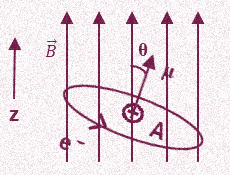
When a magnetic field (B) is applied along, say z-axis, work is done on the dipole by the torque or force that acts on it due to the applied magnetic field, to orient it along the same direction as B.
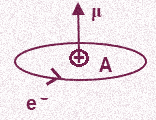
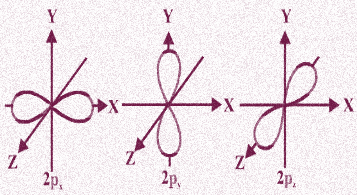
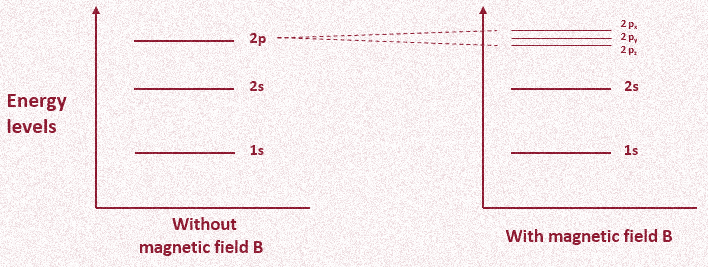
Now, in order to understand the Zeeman effect, we have to go a little back to the electronic configuration of an atom. In an atom, the electrons occupy energy states (also known as orbitals) around the nucleus and each electron has its own magnetic dipole moment due to its angular momentum and charge. This dipole moment (μ) is directed perpendicular to the area (A) covered by the electron around the nucleus (shown in Figure 1). Each energy orbital (s, p, d, f etc.) of an atom can be further split into sub-levels according to the rule: (2l + 1), where l = 0 (for s), 1 (for p), 2 (2 for d) and so on. For a given l, these sub-levels have the same energy (degenerate) in absence of any magnetic field. When a magnetic field (B) is applied along, say, z-axis (Figure 2), work is done on the dipole by the torque or force that acts on it due to the applied magnetic field, to orient it along the same direction as B. Now the splitting of the orbital occurs because the work done or energy required to align each sub-level along B is different for different sub-levels of the same orbital. For example, 2p energy level has an orbital quantum number (l)= 1 and so the number of sub-levels it can have are (2l +1) = 3 (i.e., px, py, pz in Figure 3). Now, these sub-levels are oriented along different axes x, y, and z. Hence different amounts of work need to be done to make all the p-orbitals direct along B. This orbital splitting can, therefore, be represented in the form of different energy levels as shown in the Energy diagram (Figure 4).
The Zeeman effect was first applied to solar physics in 1908 by George Ellery Hale, one of the best known solar astronomers, who observed the difference between two spectra from a sunspot and this led to the discovery of the existence of strong magnetic fields on the Sun. Today, this effect is being used to create magnetograms which show the variation of the magnetic field on the Sun. It is also utilized in laser cooling techniques in which atomic and molecular samples are cooled down to near absolute zero. The Zeeman effect finds its application in the medical field as well, such as magnetic resonance imaging (MRI) in which radio-frequency radiation is passed through the patient and when the protons (present in water molecules of the human body) get excited to higher energy states and again relax off to the lower energy state, this energy is detected and measured in order to diagnose the suspected body parts.
About the author
Raveena Khan is an Integrated M.Tech-PhD student at IIA and she works on Solar spectropolarimetry.