How many nights does it take to count the stars?
Indu Gopalakrishnan
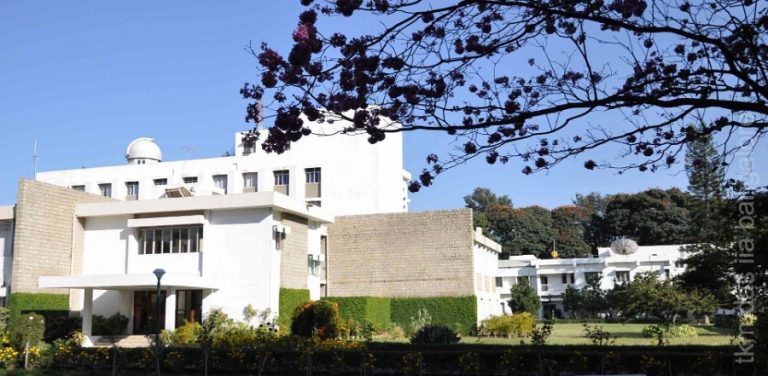
One fine morning, 14 years ago, I walked into the Indian Institute of Astrophysics to attend my first ever interview as a research trainee. I had a file with all my certificates and scorecards arranged neatly in it that I held so tight to my chest, hoping that the good credentials I earned would bless me with some confidence. My heart was throbbing with a mix of emotions, joy, fear, enthusiasm, and excitement. The campus was filled with young aspirants. They were everywhere, at the reception, the canteen, the green lawns, the tea lounge, and the long corridors. I was a fresh post-graduate in Physics with excellent academic records, average practical skills, and least exposure. My MSc batch mates and I never had an idea about the existence of any research institution (other than ISRO, of course) and the opportunities they provide. It was a newspaper advertisement accidentally noticed by my mother and the fact that my father and my brother were working in the same Bengaluru city, that paved my way to appear for the interview.
In that interview, around 15 students were selected as trainees. I was assigned to the HAGAR project with Prof. R. Sreenivasan in the department of Electronics. I happened to be the only female in the department during that period. New programming languages, interfaces, circuits, and their designs, calibrations, writing reports, long bus journey, traffic, the rush of people speaking different languages, everything at the institute and the city was new to me. In general, the traineeship doesn’t bear a predefined set of duties or activities. One must pick any work assigned that is related to the project.
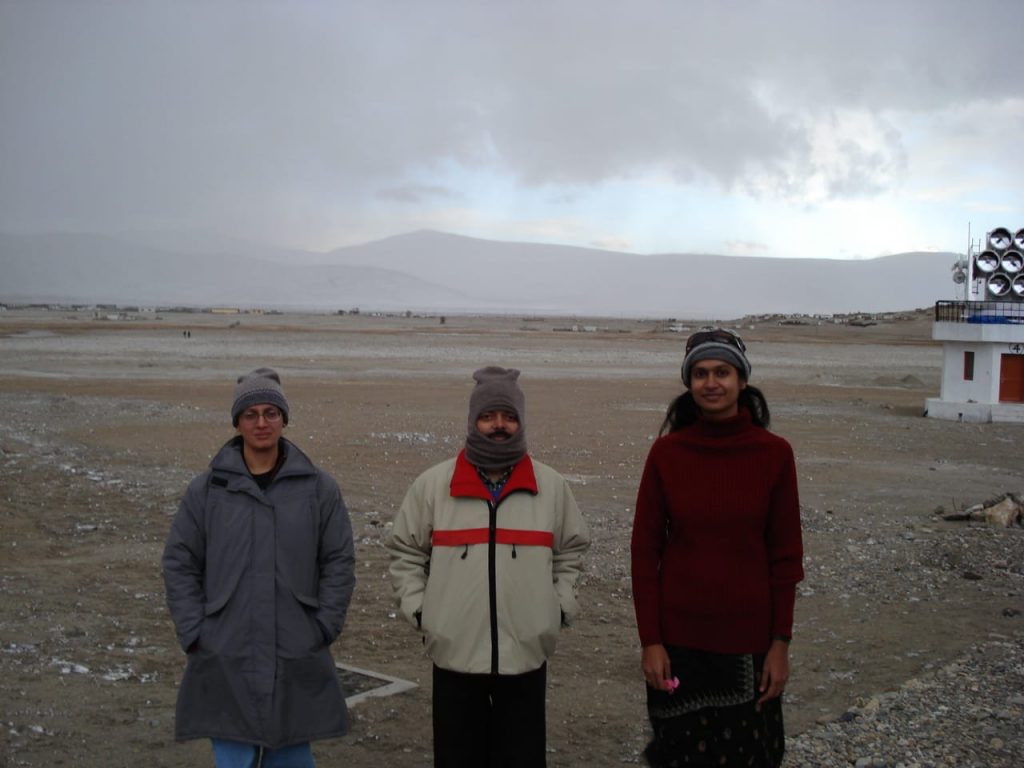
I was sent on a field trip to the Indian Astronomical Observatory, Hanle, for a month, to help with the calibration works of the telescope. Hanle, the cold desert, was again a place of surprises. I never thought in my 25 years that the wind could blow so strong and cold to make myself run from one shelter to another to save my cheeks from cracking, considering it was the only part of my body that was exposed to the cold and thin air. In the telescope house, once the switches are ON, the heat produced by the back-end electronic circuits after a while was way warmer than the room heater! I got an opportunity to cultivate and improve my practical skills, from focusing on the small knee telescope to calibrating and checking the modules of complex electronic circuits.
For the first time in my life, I saw the enchanting, bright, translucent, giant arch-like patches of the Milky Way across the sky. I realized that the picture in my imagination, which I got from textbooks, was in no way close to reality. The sight was beyond any kind of description. It seemed the province of Hanle was isolated from the rest of the country or the world by the surrounding mountain ranges. The culture, religion, food habits, flora and fauna, the colour of the sky and the sands, the wind, the water, everything appeared to be different. But the most notable thing was the contentedness of the people. They didn’t seem to be ambitious. A person from the city could easily list out several discomforts over there. But the natives seemed to be happy with what they had. The extreme cold weather brought people closer to each other and added warmth to their attitudes and relations. Their life was so peaceful, like the meditating Buddha sculptures seen in the monasteries.
The traineeship turned to be monotonous and boring in a year, as the work was more or less the same every day. At the same time, deep inside I started to feel that this was the place where I belong. People used to tease me then for my resemblance with Prof. G C Anupama, maybe because of my height or my gait. I decided to prepare for the PhD entrance. Thanks to the long bus journey from RT Nagar to Koramangala that helped me in my preparations to clear the entrance exam. During the course work is when I made lots of friends, and it obviously turned out to be fun. That was the time IIA started the Integrated MS PhD and Integrated MTech PhD programs. Our batch of PhD scholars seemed to be the largest in number till then. During my school as well as college days, I was compelled to have a studious, “good girl” image as my mother and relatives were all teachers in the institutions I studied at. So, the IIA coursework time turned out to be my real and joyful campus days.
I joined Prof. Annapurni Subramaniam to work on Magellanic Clouds. She was not just a guide to help me in my academics, but also provided plenty of opportunities that exposed me to various activities ranging from writing an administrative request letter to organizing an international event, with every finest detail taken care of. She always had her own special way of doing things gracefully. The same year I registered for my PhD, IIA opened the beautiful Bhaskara guest house and I shifted there along with most of my batch mates. The place happened to be so warm, where no one could ever feel lonely. Anyone who stayed there will definitely miss the lively atmosphere, the discussions, the celebrations and the surprise parties that used to happen quite often.
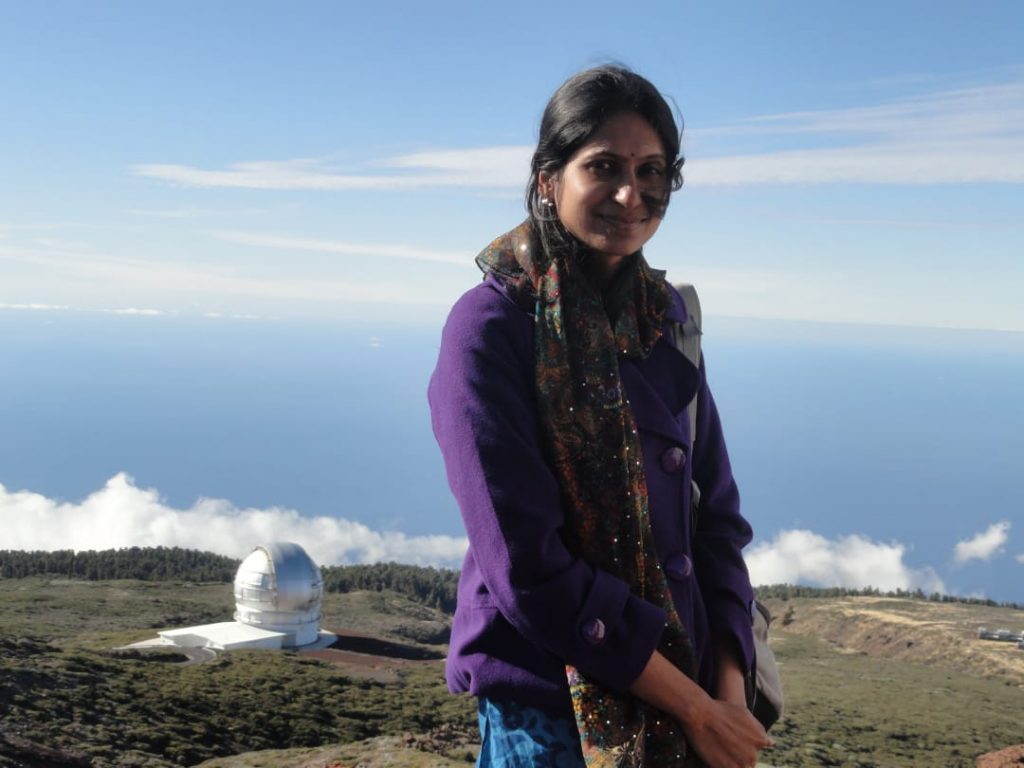
In the second year of my PhD, I made my first trip abroad to the Canary Islands to attend the famous Winter School of Instituto de Astrofísica de Canarias and to present my first publication on The star-formation history of the Magellanic Clouds. The mesmerizing Islands, even though ruled by the Spanish government, are geographically part of the African continent. We stayed by the beach, listening to the waves and feeling the sea breeze, 24 by 7. No matter wherever you start and whichever root you take, in the township and the streets, eventually you will end up near the sea. There are two incidents I remember most vividly about the school. One is my meeting with Prof. James J. Binney, the famous co-author of the book Galactic Astronomy, wondering all the time how simple, sweet, and generous his personality is. The book used to be near my pillow always, referred from the course work to the thesis time.
The second is, of course, the hike to Masca Canyon, which was part of the school. I never used to be an adventurous person who wanted to take any risk or physical hardships. So, when it was announced that due to drizzling, the rocks could be slippery and whoever wanted to step back was free to do so, I was happily standing over there just to bid goodbye to my braver fellow friends who had decided to hike. At that historical moment, one of the organizers called me loudly! (As there were only 3 of us from India, out of the 60 students, and my name was one of the easiest to pronounce, he clearly remembered and pronounced it) With the least intention to provoke or insult me, he announced if I choose to hike, he may have to carry me back. He may either have been cracking a harmless joke or maybe he was genuinely afraid, seeing my lean, feeble and tall physique, that stood out amongst the healthy-looking majority. Anyways, at that moment I decided, there is something I needed to prove to myself. I decided to go hiking without giving it a second thought. I never had an experience with hiking or trekking then. The Masca Canyon trail was all rocky, with numerous ramps and steps, and some slippery stretches with ups and downs. Around 5 to 7 km, we had to descend to reach the beach and then go back to Tenerife by boat. I clung myself to our trekking guide, who happened to be a woman, exceptionally skilled in her profession and very friendly. The couple of hours I spent with her taught me how to effectively utilize my large palms and feet, longer fingers, hands and legs to move faster in the rocky and steep paths. I was the first to reach the beach, as I was just behind the guide, and it was a moment of victory! I conquered the older version of myself, who used to step back from any kind of adventure. The trip also made me more aware and confident of my physicality. In the Canaries, like many European countries, we can find women in all skilled professions, including driving or trekking. The roads in the Island, because of their geographical peculiarity, are full of sharp turns and twists, often steeper and narrower. I was surprised to watch how gracefully and effortlessly a woman drove a bus we travelled on one such road. We flew to the La Palma Island, by a propellor type of aircraft occupied exclusively by school participants, singing and dancing all along, to visit many telescopes, including Gran Telescopio Canarias and MAGIC. We also visited the Mount Tiede observatory, where an active volcano is situated.
My long-awaited wedding (as we both belong to two different religions) and my delivery was during my PhD tenure. In my 9th month of pregnancy, just before entering maternity leave, I went to Christ University to give a general talk to students as part of the outreach programs. Those days enhanced my confidence towards life, which helped me to embrace its unexpected twists and turns. I happened to stay in Bhaskara with six months old little Nieva, a few days with my mother initially, and then alone, till her first birthday. Even for a single moment, I didn’t feel lonely or helpless because Nieva was always surrounded by people willing to take care of her. Most of the time, they didn’t notice me, sitting over there leaning over my laptop to complete the final set of modifications and corrections of my thesis! The door of my room, 409, was always open till late at night. The visitors were not only my close friends but my seniors, juniors, including the juniormost batch students, whom I had never met before, even the guests who stayed for a few days in Bhaskara and the staff. They just came in, spent time talking to her, sometimes with new toys and musical instruments played just for her. These early childhood days made a significant impact on her character. She mingles and makes friends with anybody whom she meets with the least effort or inhibition, despite their age or gender or any other aspects. Her social quotient always seems to be exceptionally high compared to mine.
We were the first batch of PhD students registered to Pondicherry University, and each trip to PU was memorable due to various reasons. Our first trip was to complete our registration process, and while returning at night, the KSRTC Airavath bus we were travelling hit a van type of vehicle in front that literally collapsed the van and crushed the front part of the bus, including the door and driver’s cabin. The driver of the bus and the people who were travelling in the van were seriously injured, and the rest of the occupants of our bus were safe but with minor injuries. We had to break the emergency window and jump outside. The scene was so horrific; the seats of the van and things were thrown everywhere, covered with blood and muck. The incident made me realize the courage and strength of the people around me, who appeared very naive and silly till then and transformed into saviours in no time with enormous preparedness and empathy.
My eventful PhD days taught me a few life skills. The skills that made me a better human and backed me up in my worst life situations are: 1) If you have an active internet connection, a system, and the skill to browse effectively and faster, you can earn expertise in any field, even the ones you never happened to come across before. 2) Any task that appears to be a routine type, like making a program or writing a report, can be made exceptional in your own ways if you are ready to invest time and effort. 3) If your plan A fails, there is always a plan B and if B fails, there is a C, then there are 23 English alphabets and more in Greek and Latin! There is always some alternative you can make to proceed, and nothing stops you other than you, yourself. 4) Wherever you go, to any nook and corner of the world, you find people who support you and make you feel homely, irrespective of your caste, religion, nationality complexion, language, gender or age. 5) Every detail, irrespective of how small it looks, matters. 6) It is always better and safer to keep your senses and thoughts open and adaptive to changes. It is not the strongest that survives but the fittest! 7) Miracles do happen sometimes, but nothing can substitute hard work and perseverance.
About the author
Dr Indu Gopalakrishnan is the Managing Director of Nucleus, the centre of science. Nucleus is an educational institution located in Palakkad, Kerala, providing conceptual in-depth learning in science for national level entrances.