Orion Nebula
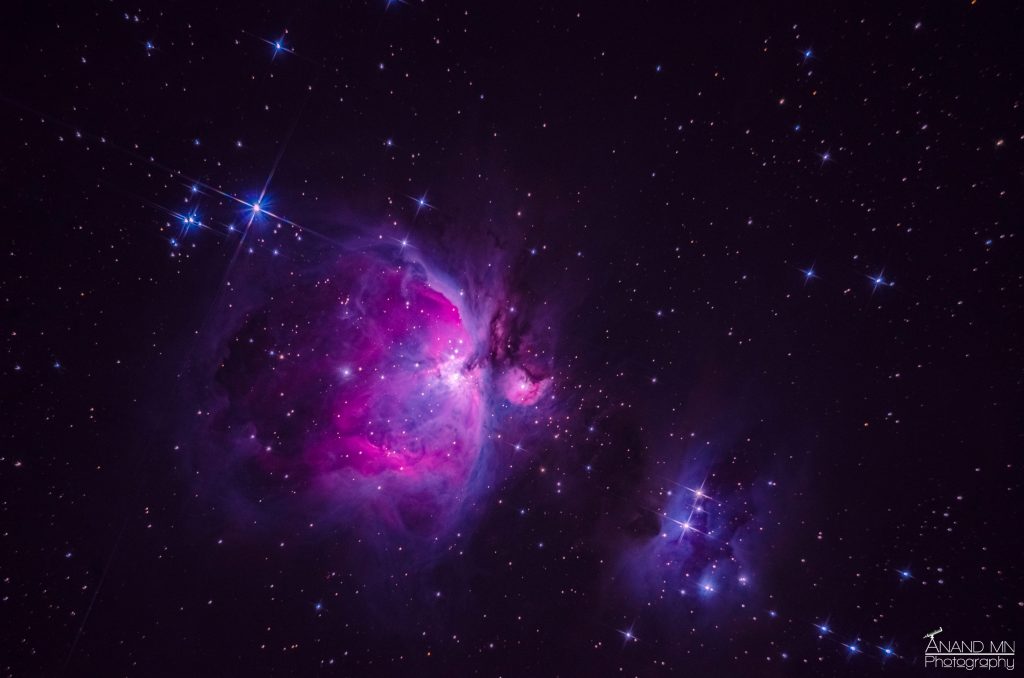
“Orion Nebula is one of the most famous deep-sky objects, which most beginners in astrophotography target. Even I did the same. My first attempt with Orion Nebula was a single exposure of 30 s, ISO 3200, in December 2018. But the core area got overexposed. Since this was my first attempt on DSO imaging using my gears, I was so excited and planned for multiple targets. So I did not give much time for any particular target. Whenever I take my telescope gears out, my friends will join me, and I will have to spare time enjoying the sky through the telescope.
Later in January, I planned the second attempt and decided to concentrate only on one object – Orion Nebula. This time I didn’t inform anyone. My wife was there to help me and one security to ensure no bison around. I captured the beauty in different exposures, starting from 10 s to 300 s at ISO 800. Ten frames per exposure, except for 300 s – 5 frames only. Total 55 light frames spending more than 4 hours under the clear sky. I also took ten dark frames for each exposure. Though it is necessary, I did not capture any flat frames – I did not know how to take it. While the camera was automatically capturing the images, we enjoyed the night sky through our binocular lying on the ground.
Winter nights are always chilling at Kodaikanal, but that night, I did not feel it at all. Maybe because of the kick from the stars. I did the post-processing using Deep Sky Staker and Adobe Photoshop/Lightroom. “
(Anand M N is a Junior Research Assistant at Kodaikanal Solar Observatory of Indian Institute of Astrophysics)
Gears Used:
Camera: Nikon D5100
Optical Tube: Skywatcher BK P130DS F/5 Astrophotography Reflector (Newtonian)
Tracking Mount: Skywatcher HEQ5 Pro GOTO Mount.
Exposure: 10 s,30 s,60 s,120 s,180 s – 10Frames, 300 s – 5Frames
ISO: 800
Intervalometer: Aputure Intervalometer for Nikon.
Location: Kodaikanal Solar Observatory, Front of the auditorium
Altitude: 2343m
Temperature: ~6 °C (As per IMD, Kodaikanal Record)