How To Know If You Are Stuck In The “miRЯor universe”? PART 2
Priya Goyal
In the previous article, we figured out a way to know if we are in the real universe or stuck in the mirror universe. Wu’s experiment, which involved radioactive decay of Cobalt atoms (cooled) placed in a magnetic field, came to our rescue. This discovery of weak forces violating parity symmetry was shocking to many theoretical physicists. To get around this shocking revelation, physicists started to think that maybe parity is not real symmetry of the universe, and hence, it is okay for weak forces not to respect it. They envisaged that parity symmetry is a part of larger symmetry, i.e., Charge Parity (CP) symmetry, which means experiments remain identical under the combined charge and parity transformation. So, in the mirror universe version of the Wu’s experiment, if we flip the sign of charged particles, i.e., we swap particles with their antiparticles; the symmetry would be restored, and again, we will end up wondering where are we; in the real universe or the negative-mirror universe!
But fortunately, in 1964, Val Fitch, Jim Cronin, and collaborators observed the CP violation phenomenon for the first time in the study of the decay of neutral kaons, particles formed by a strange quark and a down antiquark. It was found that neutral kaons can transform into their antiparticles (in which each quark is replaced with the other’s antiquark) and vice versa, but such transformation does not occur with exactly the same probability in both directions; this is called indirect CP violation. The observed effect was small, one part in a thousand, but was extremely important because it proved that matter and antimatter are intrinsically different. For this discovery, Fitch and Cronin were awarded the Nobel Prize in 1980. Hence, this experiment can also differentiate between our real and the negative-mirror universe. But wait, are we missing something? Yes, there is one more component left in this symmetry package and, i.e., the time (T) component. What about the combined CPT symmetry? Is it a real symmetry to be respected by all the fundamental laws of nature, or is there evidence of CPT violation? So far, no instance of CPT symmetry violation has been reported in any kind of experiment. This means a negative-mirror-tenet Universe would be exactly like ours and so far, we do not know any way of differentiating them. This restoration of combined CPT symmetry has an important implication.
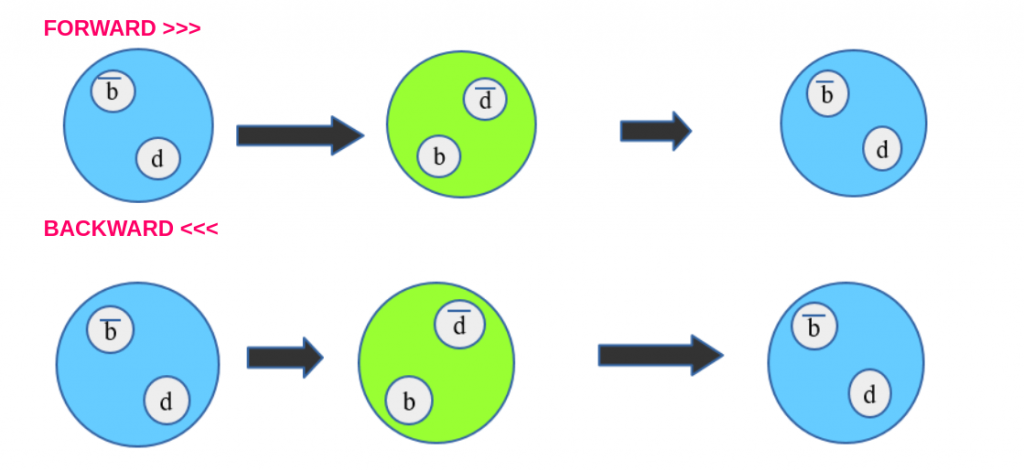
In an experiment, if there is Charge-parity symmetry violation, then the T -symmetry must also be broken in the same experiment; otherwise, there would be no way for the combined three-way symmetry to be maintained while two of the sub symmetries are broken. Breaking of time symmetry sounds very strange. But physicists have conducted experiments that confirm that certain particles break time symmetry. For example, when a pair of quarks are held together by the strong forces, there are sometimes two different possible configurations, as shown in Figure 1. These two possible configurations can switch back and forth into one another via the weak forces. But switching in one direction takes a little longer than switching in another. So, if we could record this event and play it forward and backward, it would look different. This is exactly what it means to break the Time (T) symmetry. Therefore, certain fundamental particles can tell the difference between going forwards and backward in time. Symmetries that were thought to be fundamental in nature or laws of physics, each of them over time, were demonstrably violated. However, combined CPT symmetry remains to be preserved in all known experiments, by all known particles; hence it’s impossible to differentiate a negative-mirror-tenet universe from ours, until nature offers us CPT violation.
For further discussions, please write to priya.goyal@iiap.res.in
About the Author
Priya Goyal is a Senior Research Fellow at IIA, and she works on large scale structures and effects of Gravitational lensing on CMBR.