The Shape of the Universe – Objects in the Mirror are Closer than they Appear
Fazlu Rahman
Objects in the Mirror are Closer than they Appear – A very familiar sentence to all of us. Though this is a safety warning written for the drivers who may mistakenly assume that the car behind them, as seen in the mirror is far away, given its small size, it has become a widely used catchphrase in many contexts. Here, physics is elementary. Convex mirrors, with their curvature, are used as rear-view mirrors in the vehicles to give drivers a wider field of view and to avoid blind spots. This convexity of the mirror will make the size of the object seen in the mirror smaller giving the driver a wrong notion that the object is far away.
This interesting concept in our daily life is actually helping us to get the answer to a life-long question for humankind – the shape of the Universe. Geometry of the Universe can be flat or curved (negatively or positively) depending on the matter content of the Universe; thanks to general relativity by Einstein, which relates matter distribution to the geometry of space-time and on which our improved understanding of the cosmos relies.
We define the density required to make the Universe flat as critical density. Suppose the density of the Universe is more than this critical density, the Universe is positively curved (closed Universe), and if it is below the critical density, the Universe is negatively curved (open Universe). What are the consequences of these geometries on our expanding Universe? If the Universe is closed, the matter density is dominant enough to overcome the expansion and will make the expansion eventually stop and reverse back. If the Universe is flat, the expansion rate will decrease in infinite time. For a negatively curved geometry, the Universe will continue expanding forever!
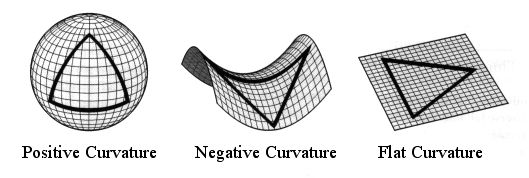
Is the Universe infinite? What is the edge of the cosmos? Where is the Universe expanding into? These are some other exciting discussions alongside. A positively curved surface like that of a sphere has no boundary, and the surface is finite. If the Universe is closed, it will be finite with no edge similar to that of a 2-D sphere. For a flat or open case, it can either be finite or infinite, given the global topology of the Universe. If the Universe is flat as a sheet of paper, the cosmological principle demands it to be infinite with no edge. However, if the flat Universe has the shape of a doughnut, it can be finite with no boundary like that of a sphere.
Now, how to measure the shape of our Universe? For any flat geometry, the Euclidean laws that we learnt in high school will suffice perfectly – the sum of the angles of a triangle is 180°, no two parallel lines meet ever, etc. To know the curvature of any space, we can check if these laws are valid or not. On the surface of a sphere, the sum of all the angles of the triangle is greater than 180° while on a negatively curved surface, say a hyperboloid, that sum is less than 180°. So, the test is simple – draw a giant triangle in the Universe and see if the sum of angles adds up to 180°.

To do this practically, we will come back to the story of convex mirrors in our vehicles. If we know the actual size of the object seen in the rear-view mirror, and if the object is seen smaller in the mirror, we say that the mirror is curved. If both the actual size and apparent size match, the curvature of the mirror is zero. The same idea can be applied to know the shape of the cosmos – we look for objects whose original sizes are known a priori and see how much their sizes vary under observation. So it is as summing the triangle’s angles and checking if they add up to 180° as per the Euclidean geometry.
Objects in cosmological scales whose size is known to us are called standard rulers. In the early universe physics, one such ruler is the sound horizon; the maximum distance travelled by the sound until the Universe becomes transparent to photons. This scale can be measured using the observations of Cosmic Microwave Background (CMB), the relic light coming from the hot big bang. Astronomical surveys looking for the large scale structure of the Universe can also measure this horizon scale, giving us hints about the curvature.
Given the powerful telescopes and high precision measurements in cosmology, recent results from CMB missions and galaxy surveys support the fact that the shape of the Universe is flat, i.e., we follow those high-school level Euclidean laws when dealing with the geometry of the cosmos. But, the story is not complete – our studies also say the expanding Universe is accelerating; the dominant entity in the Universe is dark energy having negative pressure. We need to determine the true nature of dark energy to know more about the fate of the Universe. In short, the upcoming mega telescopes designed in this direction will resolve the million-dollar questions on the apocalypse – Big Freeze, Big Rip, or Oscillations Forever.
For further discussions, please write to fazlu.rahman@iiap.res.in

About the author
Fazlu Rahman is a Senior Research Fellow at IIA. He works in the field of observational cosmology.