Miles to Go to the Edge of the Cosmos
Professor Varun Sahni speaks about his exciting career, childhood days, PhD life in Moscow, and his views on the future of cosmology

About the Interviewee
Professor Varun Sahni is an Indian theoretical physicist, astrophysicist, and distinguished professor at the Inter-University Centre for Astronomy and Astrophysics (IUCAA), Pune. Known for his research in cosmology, Professor Sahni has studied the universe, specifically its large-scale structure, the early inflationary phase, and its accelerated expansion. For Doot magazine, Sahni spoke to Fazlu Rahman and Sandeep Kataria about his academic life, childhood stories and PhD days in Moscow, his interests in arts and science, and his views on the future of cosmology.
Let’s begin with your academic life and exciting research activities. After bagging years of experience abroad working with great minds like Yakov Zeldovich & Alexei Starobinsky, you have been there in the forefront of scientific research in the country for the past three decades. How would you look back on your career as a cosmologist?
It has been a very satisfying experience. My PhD work in Moscow was done under the guidance of two great Russian theorists. Additionally, Moscow State University was well known for its fine physics and maths departments. As a result, I was exposed to the science of a very high order, which inculcated in me an appreciation for high-quality scientific research and endeavor.
I should add that when I started work on cosmology, it was still not a very popular field, and most of the great discoveries in those days were coming from other disciplines, such as high-energy physics. Even when I returned to India in 1991, cosmology was primarily driven by fine theoretical ideas.
All that changed in 1992 with the discovery of fluctuations in the cosmic microwave background made by the COBE telescope, which placed the standard model of cosmology on a firm foundation. Ever since then, exciting observational discoveries have been made almost every other year. I would never have guessed, returning to India in 1991, that within the coming three decades, so many exciting observational discoveries would have happened in cosmology, out of which three were even awarded the Nobel prize: one for the COBE discovery of anisotropies in the cosmic microwave background (CMB), another for the discovery of dark energy and a third for the discovery of gravity waves.
Looking back, I am exceedingly glad that I chose cosmology as my discipline in 1980 (when I wrote my first paper).
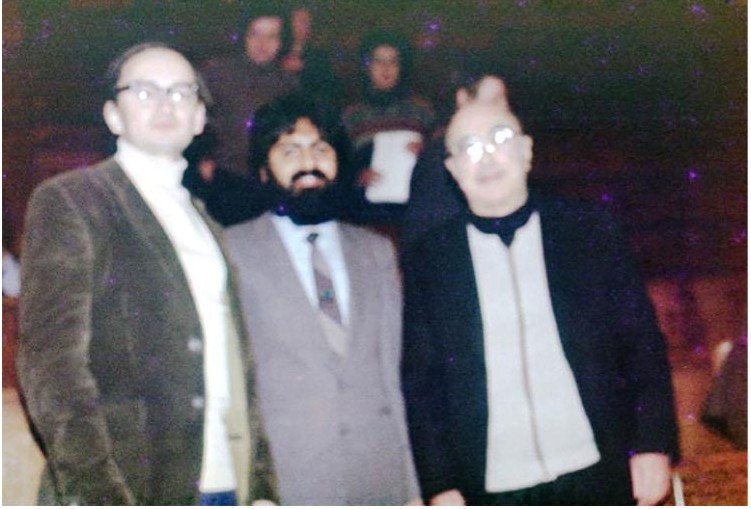
Yakov Zeldovich (right) and Alexei Starobinsky (left).
(Image credit: Varun Sahni)
You have made remarkable findings on topics like gravity waves, the cosmic web, dark energy, etc. Would you like to share some of your eureka moments with us? What is your current focus of research?
During my post-doctoral years, I helped in proving a cosmological `no-hair theorem’ by demonstrating that Inflation could arise from a very wide class of initial conditions, including space-times that were initially expanding anisotropically. Remarkably Inflation acted as a Universal Isotropiser and isotropised a universe that expanded at different rates in different directions and so did not resemble ours!
The no-hair theorem considerably enhanced the theoretical appeal of the inflationary scenario, and soon, I was invited to deliver a lecture on my findings in Cambridge. One of the great moments of my life was discussing the no-hair theorem in the presence of Stephen Hawking, who asked several deep and perspective questions. (My paper on the no-hair theorem was written jointly with Hawking’s former student Ian Moss.)
My next exciting research moment came with the discovery of tiny fluctuations in the CMB made by COBE in 1992. I remember very clearly that a copy of the press release was circulated to us by a good friend in TIFR. I was completely astounded to hear of this discovery. Scientists had been looking for fluctuations in the CMB for almost 2 decades, and none had been found. A very prominent Indian theorist was even calling this a failure of the Big Bang model! All this changed in 1992.
The importance of the COBE discovery lay in the fact that it informed us that galaxies arose out of tiny fluctuations (1 part in a 100,000) created in the early universe, perhaps by a process called inflation. So, theorists now know the initial conditions, which later grow to become galaxies.
I immediately realized that a small part of the CMB fluctuation could arise from primordial gravity waves, which, in addition to density fluctuations, are also a generic prediction of the inflationary scenario. I had then just joined IUCAA, and a clever young PhD student was working with me –Tarun Souradeep. Tarun and I began to work intensively on this problem and wrote a nice paper that was the first to extensively analyze the effect of gravity waves on the CMB. This paper was part of Tarun’s thesis and inspired him to embark on a career dedicated to understanding the CMB. Since then, Tarun has written some very fine papers on this subject, guided over a dozen PhD students, and become one of the emerging leaders of Indian science.
In parallel with working on gravity waves and the CMB, I decided to understand other aspects of cosmology, including the formation and evolution of superclusters of galaxies and cosmic voids, which intertwine together to form an exceedingly elaborate structure called the Cosmic Web. My mathematical training in Moscow (which included a course on topology) greatly helped me in this endeavor, and together with my collaborators Sergei Shandarin and B.S. Sathyapraksh, I discovered an exciting new diagnostic called Shapefinders, which could determine the properties of the Cosmic Web in a very precise manner using elaborate concepts from differential geometry and topology.
I am very happy to see that our Shapefinder work has become quite popular, and aside from being applied to the study of the Cosmic Web, it is also being widely applied to fields as far apart as nanoscale physics, the magnetic dynamo, combustion physics, turbulent flows, etc. It is always very gratifying to see one’s research is applied to fields other than the one for which it was intended!
Soon after the discovery of dark energy, I became heavily involved in developing `model-independent’ techniques that could differentiate evolving dark energy models from the un-evolving cosmological constant. Two of these diagnostics, Om and the Statefinder have become quite popular and have been successfully applied to different dark energy models. I am confident that the application of Om and the Statefinder to high-quality data expected in the near future will help address fundamental questions about the nature of dark energy and deepen our understanding of this important issue.
My most recent work has focussed on the creation of tiny black holes in the early universe. Swagat Misra (my Ph.D. student) and I have shown that black holes ranging in size from only a few angstroms to a mass greatly exceeding that of the sun could be produced in copious amounts in the early universe during inflation. These so-called primordial black holes could be an interesting candidate for dark matter.
Our model provides an alternative mechanism (to the usual `exploding stars -> black holes’) for the creation of black holes indirectly seen by recent gravity wave measurements. One of the most intriguing aspects of the cosmological model is that the universe appears to accelerate twice, initially at very early times in a process called Inflation and then about 14 billion years later at the current epoch. Although the discovery of cosmic acceleration was awarded the Nobel prize, we still understand the precise reason for the current acceleration, which is fuelled by an unknown energy source that has negative pressure and is called dark energy.
Swagat and I are proposing an elegant unification scheme in which both early and late-time acceleration are explained in a concise manner within a common theoretical framework. I am sure our paper will be of interest to cosmologists once it is published.
Cosmology is now in the phase of intriguing observations, thanks to the set of powerful telescopes available. The last seventy years have witnessed significant progress in our theoretical understanding, too. As a theoretician, how do you look into these developments? Do you think that we are at the edge of our lifelong efforts to understand the cosmos?
A very beautiful `Jugalbandi’ exists between theory and observations. Sometimes theory is ahead of observations and sometimes it is the other way around. In fact, I cannot see progress in cosmology happening in any other way! Cosmology has clearly benefited from observational discoveries in a very direct way. But the underpinning that theory provides is also very useful and important.
Recall Hubble’s discovery of an expanding universe. It is very easy to understand cosmic expansion in terms of Einstein’s theory of general relativity. I sometimes wonder how one would have interpreted this discovery had Einstein’s theory not appeared on the scene.
In this connection, you may recall that somewhat before Hubble made his important discovery, Alfred Wegener in 1912, made an equally important observation pertaining to our planet Earth. Wegener noticed that the boundaries of the different continents fit into one another like pieces in a jigsaw puzzle and also that similar plant and animal fossils were seen on different continents. To explain these observations, Wegener proposed the theory of continental drift, according to which, long ago, the different continents were all joined together and were now moving apart. (Pictorially, this appears to resemble the Big Bang model, in which galaxies that were once close together are now moving apart.)
Unfortunately at the time, no one paid much attention to this important idea, mainly because continental drift did not have a firm theoretical underpinning. Some geologists even mocked Wegener’s idea, and he was given a hard time. All that changed with a deeper understanding of the Earth’s interior, so much so that Wegener’s ideas now constitute mainstream geophysics and its common knowledge that the continents are part of Earth’s crust, which drifts on a semi-molten Magma. This process is known as plate tectonics, and on its basis, continental drift appears natural. Unfortunately, a hundred years ago, when this idea was first proposed, it went largely unappreciated.
So in a sense, it was lucky that Einstein discovered the theory of relativity in 1914 and (around the same time as Wegener’s discovery) Eddington organized a difficult experiment in its support. Recall that Eddington organised his expedition to Africa in 1919 when the world war was raging in Europe with Einstein and Eddington belonging to countries formally at war with one another. This story never fails to inspire me since it shows us the universality of science and the extraordinary cooperation across nations that is required to ensure its success.
I, therefore, believe that observational discoveries occur in two distinct ways: 1. An interesting theory makes new predictions and observations are designed specifically to test them. 2. Observations appear unexpectedly which take us by surprise and add a new dimension to our understanding of nature and to our theoretical investigations.
The discovery of the CMB by Penzias and Wilson in the 1960s and the later discoveries of anisotropies in the CMB by the space satellites COBE, WMAP, and Planck belong to the first class since the prediction of relic radiation existing from the Big Bang (then called the Primeval Fireball) had already been made by George Gamow and colleagues in the 1940s. However, the discovery of Hubble expansion, QSO’s, and, more recently, dark energy belong to the second class since they took most theorists by complete surprise.
Going by these examples I feel that future observations will also broadly belong to one of these categories. The very large galaxy survey’s being planned, such as DES, Euclid, and SKA, are sure to shed light on the nature of DE and map the cosmic web to unprecedented detail, providing much new fodder for theorists like me. And yet one hopes that surprises will also be in store for us and will propel science into different avenues and directions.
Recall that in 1900, Lord Kelvin addressed the British Association for the Advancement of Science with the words: “There is nothing new to be discovered in physics now. All that remains is more and more precise measurement.” Nothing could have been further from the truth since revolutionary discoveries such as the theory of relativity and quantum mechanics were just around the corner and changed our whole understanding of nature and the universe.
Perhaps similar advances may be in store for us now, almost a hundred years after the Hubble expansion and general relativity were discovered. Satellites such as Euclid may inform us whether dark energy is evolving or whether it is the cosmological constant proposed by Einstein way back in 1917. Cosmology has many more unanswered questions. These include the physics behind the matter-antimatter asymmetry observed in the universe (and related issues such as Baryogenesis and Leptogenesis — the origin of Baryons and Leptons and the large photon to baryon ratio), the nature of dark matter and the origin of neutrino mass. Most of these questions require answers from physics, which lies beyond the currently known (and well-established) standard model of particle physics. The theoretical underpinning for inflation and dark energy also requires looking beyond the standard model.
Therefore further advances in cosmology will necessarily depend on a deeper understanding of high energy physics and string theory. I should add that recent ideas in string theory, such as the Multiverse scenario, carry extremely radical implications for cosmology, including the possibility that our entire observable universe forms only a small part of an infinitely diverse universe, with each smaller component (baby universe) having its own fundamental laws. It would be wonderful if one could come up with observations to test this radical idea!
One also hopes that cosmology would help answer other questions of great importance to high-energy physicists — such as the existence of extra dimensions –an idea that has been around almost as long as the theory of relativity.
You already spoke about the role of students in your work. Can you please elaborate more on your experiences with students?
I regularly teach a few courses that are largely liked by students, but most of my effort has gone into research and the training of students at the BSc, MSc, and PhD levels. While working with students, I try my best to grasp their strengths and preferences for research work. For instance, if a student loves doing analytical calculations, then I place before him/her a challenging theoretical problem involving new and difficult calculations.
On the other hand, many students love numerics and data sets, and to them, I give projects that test a theory against the latest observations. That way the student enjoys his/her work and the PhD thesis proceeds smoothly. But it requires some effort on one’s part to be able to gauge a student’s aptitude correctly.
We are very eager to know about your childhood days. Have physics and mathematics always been your favourite subjects? What motivated you to pursue science, particularly astrophysics as your career?
My very early childhood days were spent in a boarding school near Shimla. There was very little light pollution in those days, and so we could see distant objects, such as the nearby mountains and even forest fires, very clearly.
In 1965 a war with Pakistan broke out and the nearby city of Ambala was heavily bombed by the Pakistani air force. The school authorities were worried that similar attacks might occur near our school and so we were made to undergo serious air-raid exercises. These mostly amounted to running towards the nearest air-raid shelter when the designated whistle was blown by a teacher. The shelter was usually a clean drain in which one had to lie face down with our fingers pressed against our ears in case a bomb exploded nearby. As time passed, we became real experts at this exercise, and no sooner did we hear a whistle than we hurried towards our shelter.
On one particular night, an interesting thing happened. We were all fast asleep in our dormitories when we heard the shrill sound of a whistle. We jumped out of bed, grabbed our dressing gowns and ran outside towards our shelters. Suddenly we heard our teacher say: `stop stop, don’t run’, `Look up, look up towards the sky’.
I did so, and what I saw there amazed me. It was a comet !!! I had never seen a comet before and it appeared to fill the entire sky. What a spectacular object! To this day I feel it was the most heavenly and beautiful sight I have ever seen in my life.
I don’t think I was the same person after that night. The fascination of the night sky and its beauty filled my mind and as I grew up I started looking out for books on astronomy. I especially loved books published by Mir Publishers of Moscow, who explained in simple terms celestial objects such as planets and their moons, stars and galaxies. I especially loved pictures of galaxies which captivated my imagination.
Very soon I asked my parents to buy me a telescope. I had seen one in the display window of a hobby store in Connaught Place in Delhi and I wanted it very much. But it cost 100 rupees, which was a serious sum of money in those days. Nevertheless, my parents promised to buy me a telescope if I would get a first division in my exams.
I told them this was a trivial matter, but try as I might, I never scored over 57% in class. One year passed and then a second. Finally, my parents relented. They probably realised that their son would never cross the 60% mark, but that should not stand in the way of his being allowed to pursue his passion, so very soon my father took me to a shop in Old Delhi and purchased me a lovely Japanese telescope for the princely sum of Rs. 310. It was mounted on a small tripod, and I adored it!
Luckily for me (but unluckily for the country), the year I got my telescope (1971) marked yet another Indo-Pak war. This time the Pakistani air force came as close as Delhi — my hometown, and three of their planes were downed just near the city’s outer defences. Because of this strict vigilance began to be observed in the capital, and the windows of all houses were painted in black to prevent light from leaking out into the night sky.
Despite the difficulties posed by the war, this was truly a heavenly time for skywatchers and astronomy enthusiasts. The lack of light pollution made the night sky pristine and beautiful.
During summer, our family invariably slept on the rooftop (barsati) of our house to escape the summer heat (there being virtually no ACs in those days). Although my parents slept soundly, I could never fall asleep and would spend countless moments looking at the bewildering plethora of stars, planets, and constellations in the sky. The telescope was my companion and I would first point it at Jupiter, then at Saturn, then at the moon. On many occasions, our relatives, friends, and neighbors would also enjoy the wonders of the night sky. (One could see well over 1000 stars on a clear night in those days.)
The 1971 war also marked another important turning point in my life, but in a different respect. The war was now raging both on India’s eastern front (then East Pakistan, now Bangladesh) and on its western. The Delhi civil authorities decided to embark on a civilian rifle training course in case the situation became more serious. Luckily a rifle shooting range was located right near my school and so the school authorities encouraged us, children, to learn rifle shooting. Right from the beginning, I loved this sport and very soon turned into an excellent sharpshooter. I finished the civilian rifle training course with a distinction (the youngest boy to be awarded this grade) and soon won a medal in the inter-school championships. Upon joining college I continued my passion for rifle shooting and soon became the Delhi State champion, the captain of the college rifle shooting team, and the winner of a gold medal in the National rifle shooting championships.
Your own story shows the curiosity of a kid to know the cosmic wonders. What advice do you like to give those children who aspire to be the next-gen scientists?
Kids must develop good hobbies, read popular science books and watch educational programmes on TV. If possible they should also become members of an Astro-club (or a similar popular science activity) in their cities and try to design simple experiments (such as making your own telescope) which can provide a lot of joy.
Too much focus on rote learning is a really bad thing, and Indian school children suffer a lot on this score. The excessive attention to marks and exams is a big spoiler to true learning. Therefore much more attention must be given to creative activity and the development of imagination.
You are a scientist from the great family of actors, writers, and artists. Can you tell us how you could integrate these ‘two cultures’ in your life?
The arts and science were never separate in my life.
I come from a family with a strong literary background. No one in my family had engaged in any form of scientific activity before me, but my parents noticed my inclination toward science and readily bought me books and other materials for experiments — I even made a small radio, of which I was very proud. Unfortunately, I did not receive any encouragement towards science in school since my maths teachers were a big bully and frequently thrashed us, kids, for no real reason. The relentless beatings from the Math teacher made me fear school very much, and my marks in that subject dipped to a new low. (One of the reasons I could seldom reach the coveted 60% mark in school.)
Despite this rather negative school atmosphere during my early years, something quite remarkable did happen. And that was my interest in music. Ever since I was a child my parents noticed that I was fond of music and helped nurture my passion. My mother enjoyed singing Hindustani classical and my sister played the piano, so I, too, learned the piano and a little later started playing the guitar.
Later in school and also in college, I acquired quite a nice collection of music including rock and classical. I believe this long exposure to music rewired my brain and very soon my marks in maths started improving. (Also, our math teacher was changed.)
So by the time I reached the 11th and was studying for the boards, I was beginning to enjoy physics and maths and also spent my leisure hours going for long walks and playing my guitar. Surprisingly (for my parents and teachers), I cleared the 11th with a distinction in maths and a very high overall score which got me admission into St. Stephens college, then the number one college in Delhi University.
In college, too, I balanced my academic activity with extra-curricular fun. I became a member of the chess club and joined the rifle shooting club to eventually become its captain. Moreover, my college lab partner, Omar Ahmad Karim, was not only a fine physics student he was also a lover of Hindustani classical music and played the flute. So after classes, we would jam together — him on the flute and me on the guitar! We became quite good and even started performing at public music events in the city. After my BSc in physics, I left for Moscow for further studies, while Omar soon left for the US where he completed his PhD.
So all through my life appreciation for the fine arts has complimented my (deep and passionate) love for science. My father always encouraged me to read good books, and there was never any dearth of them in our house.
Later in Moscow, I discovered that the schism between arts and science, which unfortunately existed in India, did not exist in Russia, and I was pleasantly surprised to see my fellow students engaged in all kinds of activities which complemented physics. To give one example, our physics hostel had a lovely music room fully equipped with instruments, including a piano.
I soon realised that some of my physics friends were exceptionally talented piano players and played that instrument like semi-professionals. Others were very well versed in literature and poetry and some loved good cinema. In fact, my cosmology teacher and guru, Prof. Zeldovich, often opened his lectures by quoting from well-known poets and writers.
Because of this eclectic atmosphere, I felt very much at home in Moscow and soon collected a small library of books that included works in science (the full 10-volume set of Landau and Lifshitz) as well as literary classics. I should add that despite its many drawbacks, soviet-era socialism had one big plus point: books and music were heavily subsidized by the government. There were over a dozen bookshops in the university, and our physics department and the physics hostel each had its bookshop where one could find cheaply priced excellent books. The Russians also had an excellent translation agency that translated the best foreign language books into Russian. So, one had access to the best physics books written in Japanese, French, Russian, and Italian. I still own a book by Enrico Fermi, written in Italian on one page and in Russian on the next!
To my good fortune, located near the Landau Institute, where I used to meet my PhD supervisor, was a huge music store. So every time after meeting him, I would go and purchase long-playing records (LPs) and soon acquired a collection of several hundred LP’s including the complete works of Beethoven and plenty of Rock music (which was banned in Russia in those days and which I procured from abroad).
What activities do you do apart from the regular academic works?
I start my day with a bit of Yoga and some meditation. I think a period of quietude especially in the morning, helps with the rest of the day (which can sometimes turn very hectic).
I continue to enjoy reading and playing music. My guitar is my favourite companion and I carry it with me everywhere I go. I also love collecting old coins and have a nice collection of ancient Indian and foreign coins. (My oldest coin goes back 2300 years.)
Through coins, I have learned a great deal of history! I also enjoy occasionally acting in plays and staged several of them during IUCAA’s foundation day. Some years ago I even acted in a feature film.
Finally, can you give some message to the budding astronomers like us to keep motivated in the field?
Love doing science but remember to mix it with other activities which you enjoy and which provide you with a nice break when you need it. Also, try and have enriching summer or winter holidays when you can forget all about work. The mind is a sensitive instrument and it needs both work and relaxation to work well. Also, each person’s mind is unique, so try and understand yours!
Interviewers:
Fazlu Rahman is a senior research fellow at IIA. He works in the field of observational cosmology.
Sandeep Kataria is a post-doctoral researcher at IIA working on galactic dynamics.