The Mysterious Exoplanets
Suman Saha
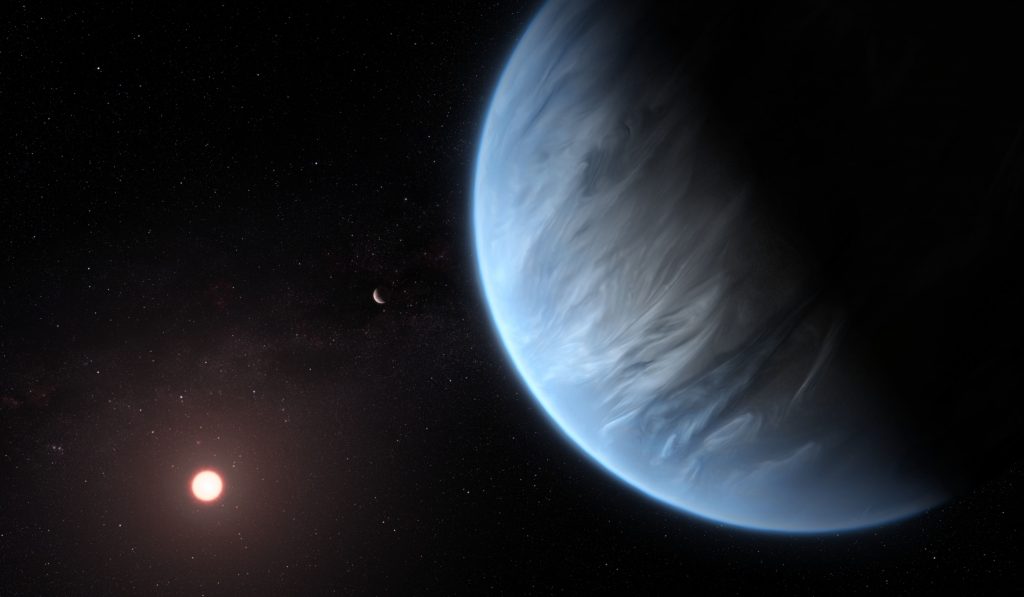
Just like the planets in our Solar system orbiting around the Sun, there are planets outside the Solar system orbiting around other stars. They are known as the Exoplanets (or Extra-solar planets). By definition, planets are much smaller than the stars and unlike the stars, they have no direct source of light but reflect the light from the stars. The starlight reflected by them is too little compared to the light coming directly from the star. This makes it extremely difficult to detect the Exoplanets by direct imaging. However, several indirect techniques have evolved over the past few decades to detect them.
The first confirmed Exoplanet was discovered in 1992 by Aleksander Wolszczan and Dale Frail. They found two planets orbiting around a pulsar, named as PSR1257+12, using the pulsar timing method. and the planets named as PSR1257+12 c and PSR1257+12 d. Pulsars are rapidly-rotating Neutron stars, which are the collapsed cores of supergiant stars (10-25 solar-masses) post supernova explosion. Pulsars have an extremely high magnetic field and emit beams of electromagnetic radiation from their magnetic poles. If the magnetic poles do not coincide with their rotational axis and the observer is somewhere in the path of the beam, pulsating beam with an extremely high and precise frequency can be observed. However, if an Exoplanet is present, this frequency varies due to the gravitational pull of the planet. The detection of this variation in pulsation is the basis of the pulsar timing technique. This method is so precise that Exoplanets much smaller than the earth can be detected. Since this method practically involves the detection of the gravitational pull of the planet on the pulsar, it also provides the accurate mass of the detected planets. However, this method is only restricted to exoplanets around pulsars, which are too rare.
In 1994, another planet was discovered around the pulsar PSR1257+12 using the same method, making it the first and only pulsar to date with three known planets. Till then, planetary systems have been found around three more pulsars. Usually, planets are not expected to be found around pulsars, since they are the end phase of stars and have gone through the supernova explosion, which emits enough energy to tear apart any existing planetary system. So, this discovery meant only one thing, the second phase of planet formation from the supernova remnants. The three planets around the pulsar PSR1257+12 are later named as PSR1257+12 b, PSR1257+12 c, and PSR1257+12 d, following the exoplanet naming convention as adopted by the International Astronomical Union (IAU) (suffix ‘a’ is not used since it represents the star itself). The planet PSR1257+12 b, which was discovered in 1994, has a mass just around 2% of that of Earth. It is the lowest-mass planet yet discovered by any observational technique.
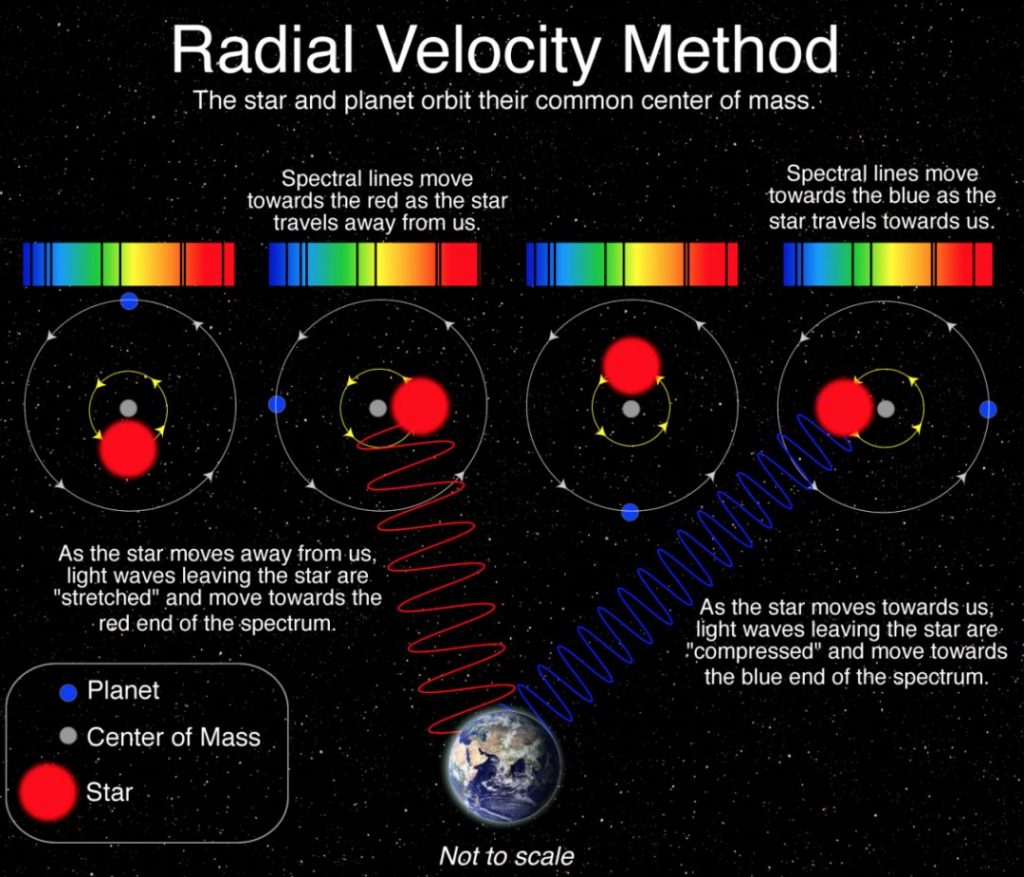
When a planet orbits around a star, the star also moves in a very small orbit of its own around the center of mass, due to the planet’s gravity. This leads to a variation in the radial-velocity (to-and-fro motion) of the star, which can be detected as a Doppler shift in the star’s spectrum (a red-shift for out-going and blue-shift for incoming). This is a very powerful technique for the indirect detection of Exoplanets, known as the radial-velocity method. In 1995, Michel Mayor and Didier Queloz discovered the first exoplanet around a main-sequence star (stars with hydrogen fusion), named as 51 Pegasi, using this method. The planet is named as 51 Pegasi b. This discovery is awarded with the 2019 Nobel prize in Physics. Although the radial-velocity method involves the detection of the effect of the planet’s gravity on the star, the limitation comes from the fact that the radial-velocity is just a one dimensional projection of the whole effect. This means, instead of providing the actual mass of the planet, the radial-velocity method only provides the minimum mass of the planet, mathematically written as (M * sin i). M is the actual mass of the planet and i, the inclination angle of the planet’s orbit with respect to the observer. Since i can not be determined from the radial-velocity observations, the true mass remains undetermined.
The discovery of 1995 was important for another reason. The discovered Exoplanet, 51 Pegasi b, was like nothing ever known of. This planet was very similar to Jupiter in size, but was orbiting extremely close to the star (much closer than the Mercury in our Solar system) with a very small orbital period. This discovery led to the introduction of a very distinct type of Exoplanets, known as the hot-Jupiters, due to their Jupiter-like size and very high temperature due to close proximity to the star. Since then, more than 500 hot-Jupiters have been discovered. Since they are orbiting so close to the stars, these planets are tidally locked, meaning only one hemisphere of the planet is always facing the star and the other remains permanently faced out. You must have noticed that you can always see the same face of the Moon, which is also due to its tidal locking with the Earth. The discovery of hot-Jupiters seriously challenged the then existing planet formation theories, since a planet this huge can not be formed so close to the star. It will get teared apart by the extremely powerful tidal force of the star during the formation phase itself. This led to theoretical speculations that these planets must have been formed farther away from the star and then must have migrated to a close-in orbit. However, there is no sufficient observational proof to verify these theories and even after 25 years of first discovery, the mystery of hot-Jupiters continues.
So, are there any cold-Jupiters too? Of course, we have one…, no, two in our own Solar system (yes, Saturn is a Jupiter-like planet). But, are there any discovered outside our Solar system? What are the other types of Exoplanets discovered? Are there any other techniques to detect them? Where is the future of Exoplanet science going? The mystery continues in the next issue. Till then…
(to be continued…)
About the author
Suman is a senior research fellow at the Indian Institute of Astrophysics. He works on Exoplanets and keeps a keen interest in science fiction.