How to know if you are stuck in the “Mirror Universe”?
Priya Goyal
This Covid-19 pandemic has forced us to live in a virtual world, where many social activities like teaching, conference presentations, dance training, karate classes (from my personal list), etc. are happening online. While participating in one of these, I am sure that at least once we all would have got confused due to the simple fact that “Left appears right and right appears left”, while looking at a person or an image on the screen. This is what we call mirror or reflection asymmetry. Let’s imagine that you are stuck in a mirror universe. A mirror universe is basically just the reflection of our own universe. It has everything just like in ours, except that our right will be their left and our left will be their right. Just like in our universe, you will see an apple falling down from a tree and stars twinkling in the night sky. Everything looks beautiful and exactly the same as ours. “So how do you know if you are stuck in the mirror universe?” Well, one way is to perform the Wu experiment!
The Wu experiment was first performed in 1956 by Chien-Shiung Wu and her team in order to test if weak forces violate Parity symmetry. The results from this experiment have taken the entire Physics community by surprise. Later, Tsung-Dao Lee and Chen-Ning Yang, the theoretical physicists who proposed this experiment, received the 1957 Nobel Prize in physics for this result. Before diving into the experiment let us understand what is so special about it.
A mirror universe is basically just the reflection of our own universe. It has everything just like in ours, except that our right will be their left and our left will be their right.
Nature loves symmetry. For example, the wings of a butterfly, spider web, a snowflake, a honeycomb, and even a human face are all symmetrical. Many of the profound ideas in nature manifest themselves as symmetries. There are three fundamental symmetries in the physical world (at the particle level) that are always expected to hold: Charge, Parity, and Time.
Time symmetry would imply that fundamental interactions work in the same way forwards or backward in time. That means if there was a tenet universe, where time runs in the opposite direction to ours, the force of gravitational attraction between two bodies will still be the same.
Charge symmetry on the other hand implies that the interactions remain unaffected if we swap the positive and negative charge. In a negative universe where the electrons become protons and vice-versa, the atoms would still exist and we will still breathe air (O2).
Parity symmetry means laws of physics are indifferent to left- or right-handedness. So, in the mirror universe, where the left is right and vice-versa, the stars would still twinkle.
This C, P, and T symmetry ensure that all physical laws will remain invariant under any of these transformations. So, whether you are in the tenet universe, the negative universe, or the mirror universe, the physics textbooks will still be the same as ours. But the Wu experiment showed a violation of one of these symmetries which we thought are fundamental.
Wu’s Beta Decay Experiment:
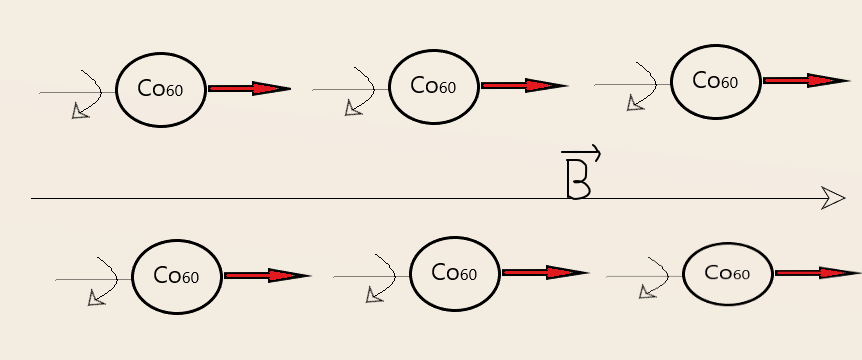
Wu and her team cooled the Cobalt 60 atoms close to absolute zero temperature and placed them in a strong magnetic field as shown in Fig 1. The magnetic field is used to align all the Cobalt atoms in one preferential direction. The arrow indicates the direction of the spin angular momentum of the Cobalt nuclei. It indicates that the spin is clockwise.
Cobalt 60 is radioactive; it undergoes beta decay via weak nuclear interaction releasing an electron.
60Co → 60Ni + e– + ῡ
They observed that electrons were emitted in a preferred direction, which was opposite to that of the spin angular momentum of the nucleus. Now, if we look at the exact same experiment in the mirror, what will happen?
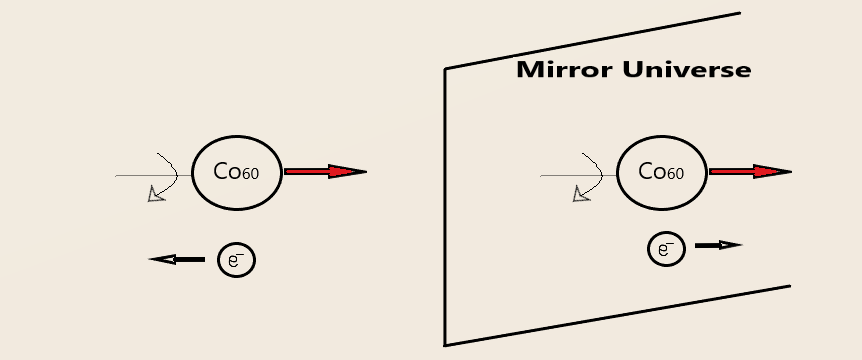
In the mirror world, the direction of the spin of the Cobalt nucleus will still remain clockwise and hence the direction of spin angular momentum remains the same. But, the direction in which electrons are released will be reversed as described in Fig 2, which makes it distinguishable from its mirror image. So when you perform this experiment and observe that the electrons are emitted opposite to the direction of spin of the Cobalt nucleus, you are in the real universe, while if they are emitted in the same direction of the spin of the Cobalt nucleus, you are definitely stuck in the mirror universe.
Whether you are in the tenet universe, the negative universe, or the mirror universe, the physics textbooks will still be the same as ours. But the Wu experiment showed a violation of one of these symmetries which we thought are fundamental.
Wait, this is not the complete story. If the mirror universe also happens to be the negative universe (all charges are reversed), the symmetry is restored (meaning the experiment results will be the same as ours). Does that mean you are stuck again? No, not really!
[Will be continued in the next edition: How to know if you are stuck in the negative mirror universe?]
About the author
Priya Goyal is a Senior Research Fellow at IIA, and she works on large-scale structures and the effects of Gravitational lensing on CMBs.