`Asimov, Basket Ball, Satellites & Dust’
Prof. Jayant Murthy speaks about his career, life stories, academic training in the United States, research experience with space payloads and UV missions, etc.
About the Interviewee
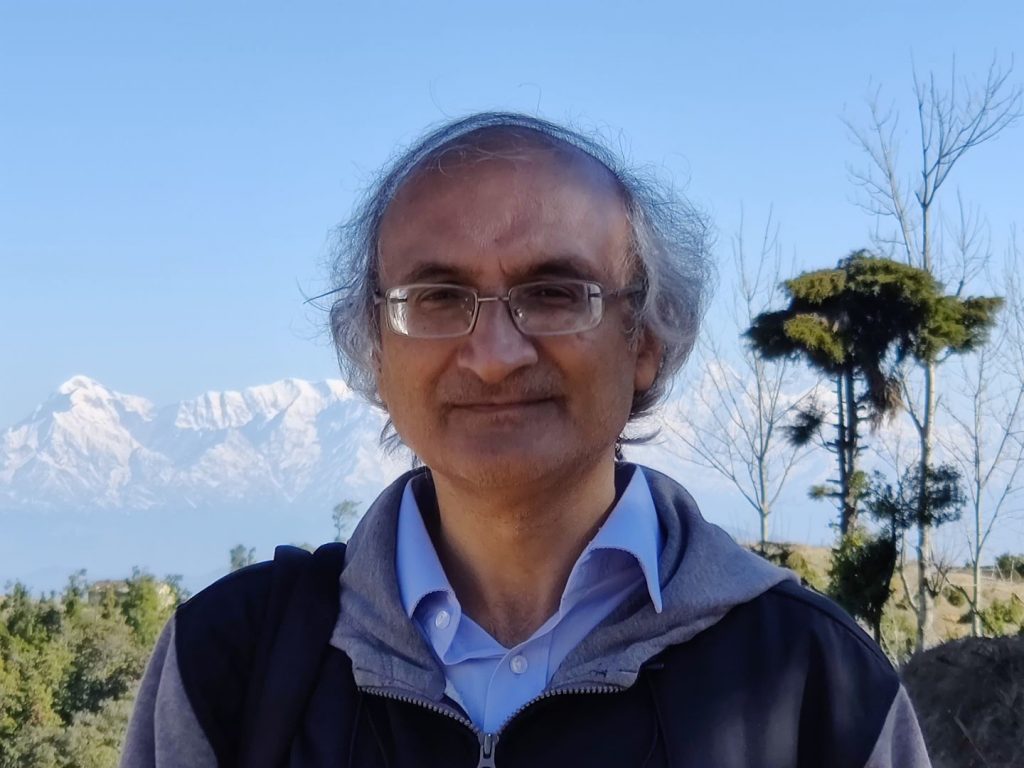
Prof. Jayant Murthy obtained his PhD from Johns Hopkins University in 1987. He went to NASA/GSFC for two years as a NAS/NRC Research Associate and then back to JHU as a Research Scientist. Since then, he joined the IIA in 1999 and has done work on topics in UV astronomy, the interstellar medium, and payloads intended for space flight. He is now working on an instrument scheduled for flight on the Chinese Space Station as part of a UNOOSA program. For DOOT magazine, Prof. Jayant speaks about his career, life, and academic training in the United States, his research experience with space payloads and UV missions, etc.
You started your university education at Johns Hopkins University (JHU) in the United States. After your graduation, you were at GSFC NASA and spent a significant portion of your research life at JHU. How did you end up doing your university education in the US?
I did my high school in Zambia (The International School of Lusaka) and was too young (14 years of age) to write the IIT exams, so I wrote the SAT and Johns Hopkins offered me a scholarship for my BA. When I finished my undergraduate degree, it was decided to locate STScI (Space Telescope Science Institute) at JHU, and I thought it would be a good thing to work with them. As it turned out, it took longer than one might think to get ST (Space Telescope) off the ground, and I was never really associated with them.
In general, I would recommend an American education because they give you a much different experience than anywhere else, at least if you go to a top-tier college. The breadth and the depth of the research are so much greater. It becomes hard to measure yourself in India because your peer group is so much smaller.
What was your PhD thesis on? We would like to know more about the later projects you were involved in at Johns Hopkins.
I first worked on a spectrograph to go on the Space Shuttle called UVX – Ultraviolet Experiment. Our instrument included two spectrographs that measured the diffuse sky background in the UV, collaborating with a similar instrument from UCB (University of California at Berkeley). We built the instrument and mounted it in a GAS (Get Away Special). At the time, NASA had thought that the Space Shuttle would provide a platform for regular science experiments. Unfortunately, the Challenger exploded just a few months after our launch (on Atlantis), and science on the Shuttle was deemphasised. I was playing basketball when the Challenger exploded, and it wasn’t until I went back to the Department that I heard. It was like a cliff. Before the explosion, there were several new jobs every week. That dropped to a few a year.
Although UVX was supposed to be my thesis project, it was delayed by two years – as is common in space projects and I got onto a project to search for hydrogen in the local interstellar medium by looking at Ly-alpha absorption against the chromospheric emission of nearby stars. I think my experience here was pretty standard by American standards. My predecessor (Wayne Landsman) handed me a program (if I remember a printout) and a stack of 8 track tapes and left for his postdoc at NASA. You get thrown in the deep end, but you learn to survive.
I spent one more year as a PDF at JHU, where I completed my analysis of the UVX data and then spent two years as a NAS/NRC Research Associate at NASA/GSFC. My prospective advisor had left, and I worked more or less independently my two years there before going back to JHU to work on a ‘Phase A’ study for a SMEX mission. This is where I became intimately involved with APL (Applied Physics Laboratory) and worked closely with the spacecraft groups there.
We then got the opportunity to be involved with a Defense Department project (MSX). This was a part of Reagan’s Star Wars, where the goal was to detect 90% of incoming Russian missiles. After the collapse of the Soviet Union, the goal changed to detect 100% of all North Korean missiles. Our part was only astronomy, and, except for the few times they observed military targets, we got to do astronomy. Unfortunately, the instrument was soon superseded by GALEX, and much of the data from the UV instruments are sitting unused.
The last project I worked on was FUSE, where I was part of the software pipeline. I also worked on several individual science projects. The most productive was working with Voyager observations and data in which I derived the UV background based on observations from 1 AU to 50 AU.
Can you share some memories as a PhD student and later on as a research scientist at Johns Hopkins?
I enjoyed my time at Hopkins much more than at any other place. We had a beautiful campus that felt academic. There were always students around but in an urban environment where you had to be part of the city. I lived in some pretty bad places off-campus and would sometimes hear gunshots just outside my apartment. I had pretty much the same routine. Go into work by 9, play basketball at lunch, go home at 5, make dinner and then go back to the office until about 10.
When I started grad school, we had a communal office with the 25 of us (only 8 got their PhDs), from which we were ejected when the Space Telescope came. In the luck of the draw, I got an office in the basement with no windows. When I came back to Hopkins after NASA, we had moved to Bloomberg, and I had a nice office with a window.
My life was devoted to basketball which I played twice or thrice a week, and then to ultimate frisbee twice a week. Basketball at lunch and frisbee at 5, usually not on the same day.
You have done wonderful work in interstellar dust and diffuse UV radiation. Can you shed more light on your work and the recent developments in these fields?
The interstellar medium has been a niche area in astronomy that has its pluses and minuses. On the plus side, there is time to think, and you don’t have to worry about other people working on the same problems. On the minus side, you don’t nearly get the citations that other people get.
I started with working on the gas, mainly hydrogen and deuterium, in the local interstellar medium and calculated the D/H ratio, which sheds light on the conditions in the Big Bang. Since then, I have done some absorption line work to look at the role of carbon in the ISM but not much more. I have worked much more on diffuse radiation, particularly after the launch of GALEX, including publishing the first UV maps of the diffuse radiation in the sky. We always make incremental advances, and we are still in the early stages of our work. One of the more exciting developments is that we have found a new component of diffuse radiation, which we are still trying to pin down.
You have been a part of various space-based payloads, both in the US and in India. You also lead the High Altitude Balloon group at the IIA. We are excited to know more about your experiences with these missions.
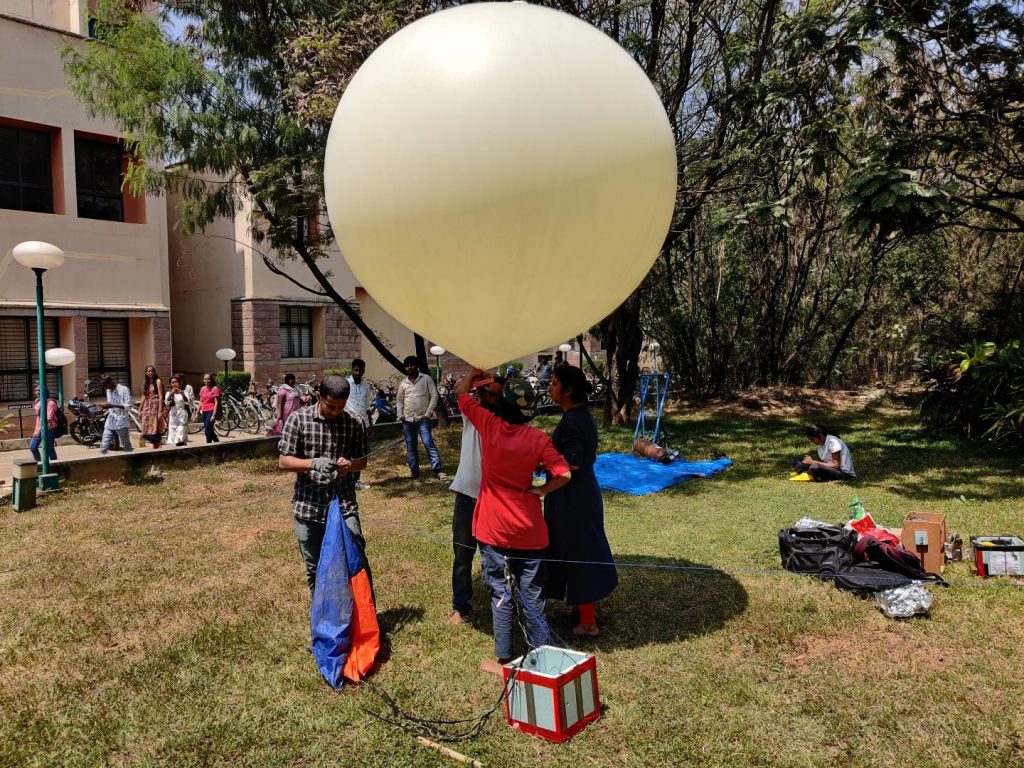
The difference between the US and India is the size and the professionalism of the team. We had 5 PhD scientists just writing the software pipeline for FUSE. I felt that the team in charge of UVIT lacked enough expertise in UV astronomy. This is one reason that I started the balloon group. We are now working on small projects which a small number of people can do. Each of the instruments we have built to date was done by one student who was responsible for all aspects of the mission (Joice for LUCI, Mayuresh for StarSense, Ambily for NUTS, Nirmal for SHS – Sreejith started the whole process but did not have a payload of his own). This has been excellent training for the students, and they are now all doing very well in their new jobs around the world.
What are your expectations about your upcoming projects like SING and TINI? Could you give us an update on their current status?
SING and TINI are both related in that they are spectrographs to look for diffuse line and continuum emission. SING has a launch on the Chinese Space Station, and we have to deliver by the end of 2022, a challenging goal. We have most of the items needed and have completed much of the design. The team (Rekhesh, Rita, Binu, Richa, Shanti, Bharat) is good but will have to pick up the pace. As I said earlier, we never have enough people.
TINI is a collaboration with people at Tubingen for which we are asking for a secondary launch on an ISRO mission. We have submitted the proposal to ISRO, but given the pandemic and ISRO’s reorganisation, we are unsure what the status is. The priority is SING, but we can reuse much of the SING development to speed up TINI.
We have another payload that we hope to have launched before the end of the year on the ISRO PS4 – our star tracker. It will not do much science, but it will be good to get data and prove our concepts and builds.
CubeSats are a popular concept for modular payloads with minimum development time. But how suitable are they for science-oriented missions? Do you think they might play a crucial part in future space missions?
CubeSats are interesting but challenging. They have to be treated just like any other space mission, with realistic and achievable goals. Their science will always be limited just by sheer size. But they can make contributions in specific areas, and it is not so difficult to think of use cases. For instance, our NUTS payload is close to as sensitive as UVIT but was built for under 20 lakhs. One could easily launch 10 of them or even 100 for less than the cost of UVIT for continuous monitoring of the sky – an LSST in space. Another possibility might be to launch a telescope to monitor Proxima Centauri for six months looking for flares with a cadence of seconds. So, with appropriate science cases, we can build payloads for a relatively low cost and all done by students.
Public speaking is an important skill every scientist should nurture. It’s tricky to convey information in a simplified manner while keeping facts intact. You are an excellent public speaker and give a variety of scientific seminars. Can you highlight the major points to keep in mind while giving a popular science talk?
Over the last two decades, I have averaged about 20 talks per year, all online this last year, of course. These talks have been at all levels, from a first grade class in Pakistan to college students, but the key is to talk in ordinary English with no buzzwords. (Unfortunately, my skills are not good enough for science talks in other languages.) I do have slides, but really all I do is to tell a story. It is odd because I am an introvert, but I enjoy telling science stories. My proudest moment was when I gave a talk in Mysore as part of a “Frontiers in Science” session, just after the LIGO observation of gravitational waves. Everyone else had prepared talks in their own areas, as had I, but when it came to my time, I told the audience that I would throw away my presentation and just talk about LIGO. It went great. The key to give talks is to speak slowly and conversationally. Keep it simple without condescending, whatever the level. It all depends on the individual, of course, but I never practice. It’s always a stream of thought. I do find, though, and this is difficult in online talks, that I do better if I can see the audience and how they are reacting. I do the worst when it is clear that the audience doesn’t care and almost put myself to sleep.
You are very active on Facebook, engaging in various discussions on social issues. What made you come to social media, and what makes you stay?
In social media, I enjoy Facebook but don’t do anything else. I have a wide range of interests, and I post what I think on many different ideas. I’m pretty far over on the liberal side, socially and economically, and I see FB as a way not to let my voice be lost. I wish I could be a true activist and actively increase change in society; this is my way of doing so while continuing my science.
Having spent ample time in both US and Indian academia, what are some of the features you think we could adapt from the US to help improve the research environment in India?
Every system has advantages and disadvantages, but it is better to just talk about improving our own system. The two biggest problems that I see are the hierarchy and the mistrust. Because of the mistrust, only Directors are allowed to make decisions. As a result, the initiative is lost. Everyone looks to only doing things the Director would approve of. This is not true in the US. No one even sees the President or any of the Deans or even the Department Chairman. You do things and assume the University will back you up if needed. I would advocate a system where people do things as they want and are given support to the level required.
What do you think about the condition of space research in India? How does the future of Indian space research look to you?
The ISRO missions are not science-oriented. They are technical missions that have done well, technically. But science is reflected by publications, and we have not done well there. We have also failed in setting up groups that will have a continuing series of missions, as it was at JHU in my time. I believe this is because of the mission-oriented system rather than a people-oriented system. My recommendation would have been to fund groups for less ambitious projects and support them through fruition. In time, this would have grown into a robust space community able to participate at par in international missions. Our science community has lacked long-term vision.
What is your take on the private space industry in India? Do you think private players are essential to foster the growth of science and technology? How do you see private-public partnerships in space research?
There is a healthy private ecosystem with large companies such as Godrej and L&T, but they work in limited areas. When I was putting together missions in the US, we would work with spacecraft contractors like Ball Aerospace, but this is not possible in India because ISRO does so much. The new vision is that ISRO will focus on research, and we will see if this makes a difference.
There is an enthusiastic crowd of small companies who have hopes of making it big. I think they have overestimated the size of the market and are not realistic in their goals, but, no doubt, some will survive and do well.
You have been associated with IIA for over two decades and have acted as the institute’s Director. We would like to hear about your life at IIA. Can you tell us how the institute has evolved over the last 20 years?
When I joined IIA, many of the people had been hired by Bappu when the Institute had a focused goal. Cowsik brought in a more diverse group of scientists without the same emotional attachment to the old observatories, and it has shown in the overall decline of VBO and Kodaikanal as productive scientific facilities. The Institute hires top-notch scientists but, inevitably, no longer has institutional goals other than maximising the science output. Whether this is good or bad is a matter of opinion.
I would like to say with gratitude that IIA has never tried to interfere with my work. I have never asked for permission and have never been told not to do something. On the other hand, I have never had active, or even passive, encouragement.
As a voracious reader who does not limit himself to scientific books, could you tell us how it has helped in shaping your worldview?
The main reason I became a scientist is because I want to know how the world works, not just astronomy or physics or even just science, but history or politics as well. So I read a lot and synthesized it. You learn so much about the diversity of people and the troubles they face just by being born in the wrong place at the wrong time. I just cannot understand bigotry and prejudice when, but for the grace of God, there go I.

Are you a big fan of science fiction? Can you tell us some of your favourite titles? Given Star Wars and Star Trek, which would you prefer?
I grew up in either the Golden Age of SF (or the Silver Age, depending on who you talk to), reading Asimov and Clarke. This was a time when science was triumphant, and there was no doubt that we would go far and fast on the wings of science. Science fiction has changed since those days and has become less focused on science and space opera and more on humans and their interactions. Many might say it has matured, but I miss the innocence of those days. On the other hand, we are also more aware of the dangers of a technocratic view of the world in which we solve every problem with engineering. We know that dams can cause ecological stress, that the interlinking of rivers will introduce unforeseen problems. Nature is too complex for us to mess with randomly. So, now, I read less science fiction and more fantasy.
I much prefer Star Wars to Star Trek. There were a few exceptional Star Trek episodes (Mirror, Mirror; the Trouble with Tribbles; Khan), but, on the whole, it has not aged well. Star Wars came out in 1977, and I saw that in the theater. What an experience that was, seeing it in 70 mm. It’s still my favourite movie, although it is not the best. I then followed along with the entire series. Even with those ridiculous Ewoks, Return of the Jedi was a great movie with the redemption of Darth Vader. Then came the three Abominations whose names I will not utter. Like the entire Star Wars fraternity, I waited for TFA with trepidation, not helped by the two weeks of delay in India because of some Salman movie or other. It turned out that getting rid of George was the best thing that could happen to Star Wars. The Last Jedi is, in my opinion, the best of the entire set with a new vision of the Universe, and it was a shame that Rian Johnson did not direct The Rise of Skywalker, which was almost as bad as the Abominations. Of all the Star Wars movies, though, my favourite is Rogue One.
Interviewers: Vishnu Madhu, Fazlu Rahman, Raveena Khan and Rishabh Teja