Govind Swarup – A Tribute
Kshitij Bane
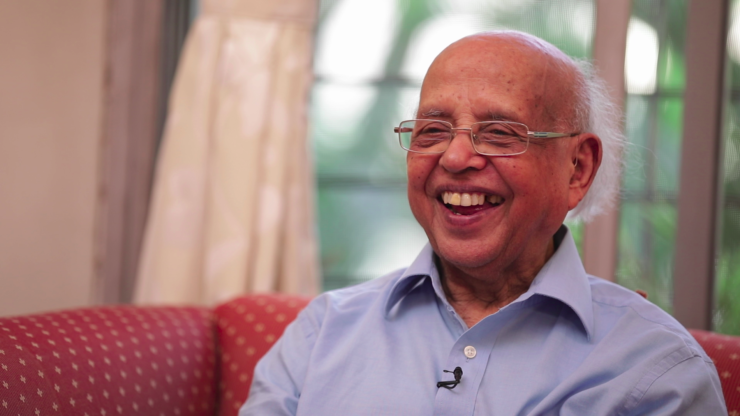
An internationally renowned astronomer, a pioneer of radio Astronomy research and torch-bearer for building and nurturing scientific capacity in post-independent India, an innovator responsible for creating unique and world-class scientific facilities, a mentor, and an inspiration for generations of young astronomers – Professor Govind Swarup, who passed away on 7th September 2020 in Pune at the age of 91.
It is because of Govind Swarup’s vision and achievements that India is one of the leading communities in the field of Radio Astronomy today. He indigenously designed and established powerful and unique observational facilities like the Ooty Radio Telescope (ORT) and the Giant Metrewave Radio Telescope (GMRT), which are among the best in the world.
Born on 23 March 1929, in the small village of Thakurdwara (now in the state of Uttar Pradesh), Prof Swarup completed his MSc degree from Allahabad University in 1950 and joined the newly formed National Physical Laboratory (NPL) in Delhi. There he worked under the eminent physicist K S Krishnan in the field of paramagnetic resonance. With the leftover parts from a radar used in World War II, Swarup set up a device to measure the spin resonance of electrons at microwave frequencies. Impressed by Swarup’s work and intrigued by the progress of CSIRO’s Division of Radio Physics in studying the Universe at radio wavelengths, Krishnan recommended Swarup to join the Australian group at Pott’s Hill, near Sydney. Swarup spent two years there working with Prof Joseph Pawsey building a radio array to study the Sun. Swarup joined the Fort Davis Radio Astronomy station of Harvard observatory in 1956, where he built an apparatus to detect radio bursts from the Sun and discovered Type-U Solar bursts. Then he joined Stanford University, California, to work on his doctoral thesis with the renowned radio astronomer Prof Ron Bracewell. After finishing his thesis on the studies of the Sun using the cross-antenna interferometer, he worked as an Assistant Professor at the Stanford University on a three-year appointment. He was also offered positions at the University of Illinois and the National Radio Astronomy Observatory, USA. But he had a desire to contribute to the scientific endeavours in his home country and decided to return to India.
Swarup, along with three radio astronomers, Prof. Kundu, Krishnan, and Menon, wrote to various Indian institutions about setting up radio observation facilities in India and their importance in strengthening the science and technology infrastructure of the country. The visionary scientist and founding director of the Tata Institute of Fundamental Research (TIFR), Dr Homi Bhabha, understood the importance of this proposal and responded positively. In 1963, Swarup returned to India and became a part of the Radio Astronomy group at TIFR.
With the antennae dishes acquired from Pott’s Hill telescope, the TIFR group under the leadership of Swarup established a radio telescope at Kalyan (near Mumbai) in 1965. Later, the group found a hill near Ooty in Tamil Nadu where the slope of the hill matched the local latitude exactly. This led to the birth of the Ooty Radio Telescope (ORT) – a smart design that uses the rotation of the Earth on a natural Equatorial mount to track celestial sources. With a parabolic cylinder antenna and an operational frequency of 327 MHz, which hadn’t been well studied before, the Ooty Radio Telescope became operational in 1970. Its objective was to measure the structure of arc-second sized celestial weak radio sources by lunar occultation, which could be used to distinguish between the Steady-state and the Big-bang theories. In the following years, this unique and indigenously developed new radio telescope made numerous path-breaking discoveries and contributed to the studies of the Sun, pulsars, quasars, interplanetary scintillation, and gravitational lenses. The ORT is still operational today and continues to make valuable contributions to our understanding of the Universe.
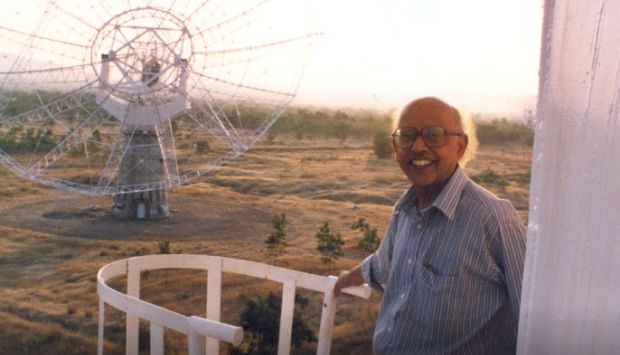
Govind Swarup was not someone to be satisfied with such an achievement. He was ready to take on a new challenge – to build the world’s biggest radio telescope at that time! In 1984, Swarup proposed setting up the Giant Metrewave Radio Telescope (GMRT) – an interferometric array consisting of 30 huge parabolic dishes spread across a 25-km area near Pune. He designed a novel low-cost, low-weight, 45-m parabolic dish antenna operating in the frequency range of ~150 MHz – 1430 MHz for GMRT. From the antenna feed to the electronic system to the Servo system, almost everything was indigenously designed and built. GMRT became fully operational in 2000, and it is utilized by astronomers all around the world to study nearly all types of radio sources. The upgraded GMRT (uGMRT) was inaugurated in 2019 on Prof Swarup’s 90th birthday and is currently the world’s most sensitive radio telescope in this frequency range. For the past two decades, GMRT has been a top astronomical facility responsible for numerous discoveries and is now a pathfinder telescope for the upcoming Square Kilometre Array (SKA).

The ORT and GMRT are testaments to Swarup’s vision, passion, and persistence. He was not afraid to take up new challenges and would strive to achieve them despite financial and technical difficulties. His philosophy was to “think big”. He always came up with out-of-the-ordinary, novel ideas and found ways to turn them into realities. These massive projects also produced an ingenious and capable bunch of young engineers and scientists. Swarup trained and mentored them over the years and turned them into experts not afraid to think big. Swarup won many national and international awards in his life – the Padma Shri, the Shanti Swarup Bhatnagar award, and the Fellowship of the Royal Society, to name a few. But inspiring generations of young students seem to be his greatest reward.
Apart from his engineering expertise and in-depth knowledge of Astronomy, Swarup was also an advocate of science popularisation and scientific temperament. He put efforts to improve the quality of science education in India and believed in a more practical and research-based education. He started a bunch of summer schools to get science and engineering students excited about Astronomy. He played vital roles in the establishment of the Indian Institute of Science Education and Research (IISER) and the Joint Astronomy Program (JAP).
I was lucky enough to meet him in person once. This was during the URSI Asia Pacific Radio Science Conference 2019 in Delhi, a couple of days before his 90th birthday, where he gave a talk on the growth of Radio Astronomy in India. Even at that age, he was full of energy and enthusiastic about new ideas, meeting young astronomers, and talking with them. Even after his retirement in 1994, he continued working and doing research. He kept exchanging ideas with his peers and students till his last day.
Prof Govind Swarup may not be with us physically, but his legacy continues through his projects. He will continue to inspire young students and astronomers. He will be remembered for his role in shaping India’s science and technology capacity, and for establishing India as one of the world’s leading communities in Radio Astronomy. Govind Swarup steered us into the future and the future will always remember this legend.
Govind Swarup – the Father of Indian Radio Astronomy
(23rd March 1929 to 7th September 2020)
About the author
Kshitij Bane is a Junior Research Fellow at the Indian Institute of Astrophysics and currently building a Radio Telescope at Gauribidanur Radio Observatory to study Pulsars.
Email: kshitij.sb@iiap.res.in