
New Books for recommendation (February 2025)
- Her Space, Her Time: How Trailblazing Women Scientists Decoded the Hidden Universe / Shohini Ghose, The MIT Press, 2025, 272 pp., ISBN 9780262552998, $22.95

Review
Author Shohini Ghose is herself Professor of Physics and Computer Science at Wilfred Laurier University in Canada, and has been active in women-in-science issues for some time. Here she addresses seven topics in the recent history of physics, astronomy, cosmology, and such, focussing on contributions by women to our present understanding. You will find here many of the astronomers you might expect — Annie J. Cannon, Cecilia Payne-Gaposchltin, Henrietta Leavitt, Margaret Burbidge, Maria Mitchell, and Vera Rubin, with, I think, no major surprises in how the author describes their best-known contributions. At least the tip of the physics pillar might (should!) also be familiar — Lise Meitner (fission, who should have shared Otto Hahn’s 1944 Chemistry Nobel), Maria Salomea Sklodowska (who received two Nobels, Chemistry and Physics, as Marie Curie), and C. S. Wu (Wu Chien-Shiung, the experimenter who found parity non-conservation as predicted by C. N.Yang and “E D. Lee, who got the prizes). Surprises and potential disagreements arise when one looks more closely at who’s in, who’s out and how the work and the person get classified. There is Margaret Burbidge (with her birth surname misspelled as Peachy rather than Peachey), sharing a chapter called ‘About time: discoverers of the Big Bang’ with Henrietta Leavitt. But Margaret was not a strong supporter of a hot, d.ense early Universe even in 1957 when the monumental B2FH, ‘Synthesis of the Elements in Stars’, was published, and later in life definitely favoured some sort of quasi-steady-state or cyclic universe without a Big Bang starting time for everybody. The chapter ‘Escape Velocity: Pathfinders in Space Exploration’ indeed includes women who worked for NASA and other space agencies (Valentina Tbreshkova makes the cut; Sally Ride does not).
Recently hailed Katherine Johnson is there, though not featured among “the Women who Powered NASA’s Space Program”. Most strangely, that chapter includes a Turkish woman whose name appears in IAU directories as Dilhan Ezer-Eryurt. Ghose calls her Eryurt in the text; lists her publications as Ezer,
and apparently thinks that having worked at Goddard Institute of Space Studies Makes her a contributor to space science. Actually her major contribution to astrophysics was calculations of the structure and evolution of stars with Z= o, carried out with A. G. W. Cameron. She is sadly no longer with us, but was
my ‘go to’ person in Turkey earlier in the century when American physicists were worried about conditions for scientists there. The story in Chapter 6, ‘Forces of Nature: the subatomic photographers’, is a bit more complicated than the version here. Yes, Marietta Blau was unquestionably a/the pioneer of using nuclear emulsions as detectors for high-energy particles, and the Nobel went to Cecil Powell for using such emulsions to find mesons (as predicted by Yukawa who had won the previous year). What I missed were the contributions of Occhialini (who also worked with Patrick Blacken on his Nobel-graced
work) and also in Powell’s cosmic-ray group at Bristol, Cesare Lattes, who carried the technique back to his native Brazil. The Brazilian physicist in that chapter is Elisa Frota-Pessoa, who also worked with nuclear emulsions, and it is impossible not to suspect that she had learned of them from Lattes, I also felt in reading that chapter that author Ghose had not been hard enough on Herrtha Wambacher, Blau’s student and apparently a loyal Nazi, who arguably tried to take more of the credit for nuclear-emulsion work away from Blau (who was in Vienna in t 938) than she, Wambacher, deserved. Lots of surprises — Otto Hahn won a medal for his WWI service at the Battle ofYpres. The death toll in the WWII Bengali famine was apparently more like four million people than the three million I had remembered. The author is apparently not aware of programmes at many universities (including UCI) that try to arrange “spousal hires” to facilitate recruiting new faculty members (one of our best astronomers arrived as the husband of a woman selected by another department!). She apparently also is not aware that Albert Abraham Michelson did his prize-winning work in the US, and she describes Millikan as our first physics Nobelist.
The author describes a D.Sc. degree as the equivalent of a PhD (but don’t they generally get to wear nicer- coloured academic robes?). On the other hand, she does an unusually good job of tracing out the path of stellar nuclear reactions from hydrogen to iron and beyond. A few other items left me wanting to verify names, dates, and all, for instance the statement that Ray Davis detected solar neutrinos in 1965, and that Otto Frisch thought of using “pure uranium” for a fission bomb, Frisch and Rudolf Peierls concluding that a few kilograms would be enough. — VIRGINIA TRIMBLE.
2. Quantum Drama / Jim Baggott and John L. Heilbron, Oxford University Press, 2024, 352 pp., ISBN 9780192846105, £25.00

Review
Jim Baggott* is known mainly as a writer of popular-science books; the late John L. Heilbron as a historian of science. Heilbron lived in Copenhagen 1962-1963, he interviewed many of the founders of quantum mechanics, and archived and microfilmed their correspondence; he has also Written a biography of Bohr3. They have teamed up for something in-between, a popular history¬of-science book, more detailed than most popular-science hooks and a breezier read than most technical history-of-science monographs. It covers the time from the origins of quantum theory up to the present. Obviously, it can’t be even close to a complete account in only a few hundred pages. Rather, as the subtitle states, it concentrates on the idea of entanglement, covering various interpretations of quantum mechanics, philosophical issues, experiments, and practical applications. Except for the last with six, each of the four parts (which follow a nine-page prologue) has four chapters. The first part covers the early days (roughly from Planck’s first work, conveniently in the year 1900, until the end of the 1920s) of quantum mechanics and provides a basic introduction to the topic. The latter can be found in many other books; the former, with more emphasis on the people involved, is not as common in books at this level. The second concentrates more on the main theme of the book, covering events from the fifth Solvay conference in 1927 until about the end of the 193os, with the famous Einstein-Podolsky–Rosen paper and Schrodinger’s cat playing prominent roles. Quantum mechanics is no longer just a system of rules for calculating experimental quantities, but has become a philosophical subject, with topics such as the measurement problem, the reality (or not) of macroscopic superpositions, the uncertainty relation, and so on, occupying the best minds in the field, not always agreeing. The most famous such disagreements are the famous Bohr-Einstein debates. (I recently read that the traditional view is, in the physics community, that Bohr is seen as having been right and Einstein wrong, whereas in the philosophy community it is the other way around. However, that simple dichotomy is as much an oversimplification as each premise on its own.) The title comes from a quotation from Bohr: “At the next meeting with Einstein ,.. our discussions took quite a dramatic turn.” The third part, picking up after the distraction of World War H (in which many of the key players were involved in more practical pursuits) and continuing until about the end of the 19505, introduces the alternative approaches of Bohm and Everett. Interesting is the degree to which some of the `non-Copenhagen’ pioneers followed those new approaches while at the same time a new generation (Weisskopf, Wheeler, von Neumann, Wigner, etc.) took over*: Bohr died in 1962, Einstein in 1955, Fermi in 1954, Schrodinger in 1961, Pauli in 1958. (Interestingly, some of the earlier generation died much later, e.g., de Broglie in 1987, Dirac in 1984, Born in 1970, Jordan in 1980, von Weizsacker in 2007, but in their last decades they were no longer leading the discussion in the field.) There is also a good discussion of attitudes in the field as expressed at conferences (where opinions are often more clearly on display than in journal articles).
The last part introduces John Bell and the current importance of his work, e.g., the experiments by the winners of the 2022 Nobel Prize in Physics (Clauser, Aspect, and Zeilinger), quantum cryptography, and quantum effects observable in (almost) macroscopic objects. In between is an interesting discussion of popular- level mysticism in connection with quantum mechanics (Capra”, Sarfatti, Zukav5, etc.). While that is often (correctly, in my view) looked down upon, it is important to remember that Schrodinger was very interested in eastern mysticism, Pauli in the psychological theories of Jung, Bohr put yin and yang on his coat of arms, and so on. (At least Schrodinger’s ‘mystical side’ might be more akin to the religion of Lemaitre, who was a Catholic priest yet seemed to be able to separate that from his work in cosmology, which has also been the case among some more modern openly religious cosmologists such as John Barrow and George Ellis.) While there are few equations in the book, the fourth part goes into more detail than one might expect in explaining the ideas of Bell and the experiments of Clauser, Aspect, and Zeilinger. While the book can’t cover everything — and doesn’t attempt to — all the same, many readers will probably come across concepts and people usually not mentioned in overviews of (the history of) quantum mechanics, such as Grete Hermann. As such, it is complementary to many other books broadly covering similar ground. It is also better written than most books I’ve reviewed in these pages. There are black-and-white figures scattered throughout the book. Twenty-five pages of endnotes are mostly references to the sources listed on twenty-seven pages. The thirteen-page small-print index is especially thorough, especially for a ‘popular’ book, and demonstrates again that this book is a cut above most broadly similar books, both in terms of content and in terms of presentation. It should appeal to a relatively wide readership, especially due to its combination of detail and readability, including, despite the lack of astronomy, readers of this Magazine — PHILLIP HELBIG.
3. Splinters of Infinity / Mark Wolverton, The MIT Press, 2024, 280 pp., ISBN 9780262048828, $29.95

Review
While the title Splinters of Infinity might suggest otherwise, this book is a history of the debate between Robert Millikan and Arthur Compton about the nature of cosmic rays and the fate of the Universe. The book tells a chronological story roughly from 1930 to 1937, with some backstory of each
of the main characters and of the study of cosmic rays. Known for their Nobel prizes in quantum physics, Millikan and Compton both shifted their careers to
studying cosmic rays, then the cutting-edge physics of their day. Millikan, despite his prior work on electrons, believed cosmic rays were gamma rays. Compton, despite his prior work on X-rays and gamma rays, argued that they were charged particles. What’s more is that Millikan, an openly religious man,
claimed that cosmic rays were the “birth cries” of atoms being continuously formed and were proof that God’s act of creation was still on-going. Following the Scopes trial of 1925, newspapers across the country, including the Newlin* Times and the Los llrigelcs Times, revelled in reporting the most prominent American physicist pronouncing the harmony of religion and science and evidence that “the Creator is still on the job”, in stark contrast to the prevailing theory even then that the Universe would end in heat death as it slowly disintegrates. Arthur Compton, rising in prominence, confidence, and funding,
took up the challenge to align with the growing consensus, especially in Europe, that cosmic rays were charged particles. Articles chronicling the on¬going dispute appeared in dozens of newspaper articles — sometimes on the front page — for years. It may be hard to believe, even for experts in the field, that “cosmic ray” was once a household buzzword, fl-nut-page material, and the precursor to modern particle physics. Thought to be a possible source of free
energy, cosmic rays attracted charlatans, crackpots, and ‘healers’ trying to sell their products with the buzzword of the day, much like one might find ‘nano’ and ‘quantum’ attached to modern-day equivalents.
Cosmic-ray research was the biggest and most cutting-edge science around, and this book recounts the record-setting global expeditions by land, air, and sea to settle the debate. Mark Wolverton, a science journalist. and author of several books blending science and history, adopts a
narrative approach to focus on this lesser-known story of scientific history. He is meticulous, evidenced by 22 pages of endnotes that are almost entirely references to books, newspaper articles, and personal correspondence among the main and supporting characters. The book is filled with biographical and
historical details. For example, amid the “cosmic ray health centers” and comic-book stories about infinite free energy from the nucleus and from cosmic rays, Albert Einstein told reporters in 1934 that atomic energy was unlikely, giving a sense of the zeitgeist of the 193os.
This book is not technical and would appeal to any reader interested in the historical details that led to our current understanding of cosmic rays and physics more broadly. TIME magazine described the Millikan–Compton debate as “one of the most reverberating scientific controversies of the century”, more famous in its day than the Great Debate between Shapley and Curtis, but it is nonetheless a MacGuffin, a device to draw the reader in to a case study of science and of scientists, who, as always, are human. In their hunt for the secrets of cosmic radiation, they set hot-air-balloon altitude records, argue over primacy, invent the AND digital circuit, jump to faulty conclusions, drop their equipment to the bottom of a lake, and fall to their deaths in a crevasse — but save the data book. The story shows how science is a messy enterprise, full of ego and dead ends — literally! One also reads about how scientists of that time dealt with the press and public perception, in contrast to scientists of today. For anyone working on cosmic rays, this book is a must-read. While Splinters of Infinity doesn’t focus on physics that revolutionized modern technology, like atomic power or lasers, it will, however, interest readers who enjoy the personal and historical sides of science. ‘1’he reader may also find this lesser- known area of physics interesting in its own right. As Mark Wolverton writes, “Cosmic rays remain one of the most intractable scientific puzzles of all time.” — PAUL SIMEON
4. Essays on Astronomical History and Heritage: A Tribute to Wayne Orchiston on his 80th Birthday / Steven Gullberg and Peter Robertson, Springer, 2023, XLI, 700 pp., ISBN 978-3-031-29492-1, €129.99

Review
Wayne Orchiston, who turned 80 in 2023, has a great many friends, and 37 of us have contributed to the chapters of this volume. Though planned several years ago, it was not quite ready for presentation on his birthday celebration, and many months after official publication, many of us are just receiving the complimentary copies that are our second most important reward for contributing. The most important, of course, was the opportunity to say good things about Wayne! Orchiston was the founder of the Journal of Astronomical History and Heritage and still keeps a few fingers in that pie. He also founded two IAU Working Groups, and has been a leading presence in history of astronomy for many decades. Editor Robertson, after a career in science publishing, went “back to school” and earned a PhD in history of science with Orchiston. Gullberg (also an Orchiston student) recently (2024 May) announced triumphantly that the IAU Working Group he had been chairing was being abolished. Why? Because it is going to become a Commission (C5) on Cultural Astronomy. What is on these 700 pages? It has been claimed that a complete model of the Universe would have to be as large (and perhaps as old) as the Universe itself. That is, a proper description of this tribute volume would also be 700 pages long, exceeding the capacity of the brown paper envelopes in which The Observatory travels to us. But my late Aunt Esther from Missouri said every meal needed seven sweets and seven sours. So here are seven frivolous items and seven serious ones (though the distinction is probably debatable for most, depending on whether you hear Mozart’s last piano concerto as triumphant or mournful): (i) a five-metre-tall snowman on the campus of Williams College. posing with (sadly now deceased) author Jay Pasachoff and his wife Naomi, connoisseurs of solar eclipses, (a) a Chuppah illustrating a transit of Venus, quilted by author Sarah Schechner for her 2013 marriage to the mechanic
who had helped her dismantle a historic telescope, so that it could be reassembled and used for viewing the 2004 Venus transit, (m) a calendar on which February has 30 days, while Sweden was switching from Julian to Gregorian calendar as described by author Lars Gislen; (0) William Herschel claiming “the great probability, not to say almost absolute certainty of the Moon being inhabited” in the chapter by W. T. (Woody) Sullivan (more often associated with the history of radio astronomy); (6) a shepherd herding Inca constellations of the Serpent, the Toad, the Tinamou, the Mother Llama, the Baby Llama and the
Fox, followed immediately by the Roasted Guinea Pig for dinner during author Steve Gullberg’s trip to Peru, (vi) Joseph Weber with his childhood Jew-fro hairstyle only partly tamed by the US Naval Academy, shown to authors Trimble and Robertson; (i) Joe Shklovsky wearing a to-gallon Texas hat at
the Fourth Texas Symposium in Dallas (1968 December) as immortalized by the camera of author Ken Kellerman.
And the Seven sours: (1) “the sad reality that this traditional (Australian Aboriginal knowledge has been severely damned from the effects of invasion, colonialism, and community displacement” as discussed by authors Trevor Scaman and Duane Hamach, (w) “the vexed and tendentious history of lunar nomenclature that seems to have deprived some astronauts of “their” lunar craters, as pointed out by author William Sheehan (but, back at “frivolous” you should see Mount Marilyn!); (m) the crew abandoning the incandescent USS Lexington in the Battle of the Coral Ses, shortly before John Bolton joined the British aircraft carrier HMS Umcorn which just barely fit under Sydney Harbour Bridge according to Trimble & Robertson; (in) the rise and fall of time determination and dissemination as a justifying purpose for astronomical observatories, appearing in the chapters by Steven J. Dick and Roger Kinns () what is apparently a genuine 1917 photograph of Sydney Observatory followed by dismissals from the government astronomer William Cooke in beth 1925 and 1936 noted by author Nick Lomb, (vi) the sad- looking images of the sites of what were once the pioneering field stations of Australian radio astronomy,
many photographed by author Harry Wendt, (ii) the narrow bounds of what astronomy should mean, as set by Bessel writing to Humboldt encompass “precise measurement of the postions and orbits of celestial bodies their appearance and the constitutions of their surfaces is not unworthy attention, but is not the proper concern of astronomy, as quoted by [the Alan. H. Batten. Luckily he was outvoted by astronomers adopting photography and spectroscopy. And every one of the chapters from which ne ote is given above has something in it to cheer, puzzle, or inspire astronomers who are interested in our own history! — VIRGINIA TRIMBLE
5. Space: The Human Story / Tim Peake, Century, 2023, 336 pp., ISBN 9781529913507

Review
Write what you know, goes the adage.UK astronaut Tim Peake has done just that with this historical survey of astronauts as a class,spiced with insights from his own six years of training and 186 days in space. Peake’s autobiography, Limitless, received some criticism for not reaching orbit until chapter 22 out of 25, but here we’re up and away from the start.
At a time when the role of astronauts is evolving fast-with the Artemis programme due to return humans to the lunar surface, while commercial spaceflights widen opportunities to fly – Peake charts the ways their legendary ‘right stuff’ has already altered through previous history. Pioneer astronauts and cosmonauts were stoic solo voyagers.
Those who followed them were team players, flying to the Moon together or establishing early orbital stations. Today’s International Space Station crew members must be long-duration all- rounders, undertaking all manner of scientific experiments, confident with routine maintenance and even ready to pull teeth if needed – while also cutting a dash on social media.
Peake has inherited a way with words from his journalist dad. He details numerous human stories behind astronaut selection, training, spaceflight and, in the most exciting chapter, spacewalking, before viscerally sharing what it feels like to plunge your way home. It’s one thing to detail ESA’s flight assignment process, but only Peake can share what it feels like to stumble upon a leftover document on an ESA printer spelling out that he would be last (and least likely) from his cadre to fly. His summary of Yuri Gagarin’s first flight is enlivened by recalling peering down into the 250m-long, 45m-deep flame pit beside the R7 launch pad.
With 628 (and counting) people to cover, some topics get left out – UK predecessors Helen Sharman and Mike Foale are acknowledged, though there is nothing on China’s taikonauts. Ultimately a history with no big surprises, this is still an engaging read. Since the book went to press, there are reports that, if the stars align on a proposed commercial UK flight with Axiom Space, its nominally retired author might be returning to space. Astronaut times are indeed a-changing!
Sean Blair is a space journalist who writes for the European Space Agency
6. The Art of Stargazing / Maggie Aderin-Pocock, BBC Books, 2023, 256 pp., ISBN 9781785947896

Review
How many of us, young or old, have wandered into the garden in our pyjamas on a cold, dark night to catch a glimpse of the sky above? If you have, then Maggie Aderin- Pocock’s introduction to her latest book, The Art of Stargazing, will strike a chord. A space scientist, science communicator and co-presenter of The Sky at Night, she is one of the most enthusiastic and popular astronomers around today. This is a practical, easy-to- read handbook for those wishing to step outside and learn about the 88 constellations in the night sky.
Aderin-Pocock begins by warming the reader up with chapters on what constellations are, the science of stars and how to get started in observing the night sky. Her advice also includes any kit you may need. What follows on the next 212 pages is a wonderful night-sky voyage through the patterns of stars above, including some interesting and maybe lesser-known facts about each constellation and a variety of ancient global mythologies associated with them. Each page is accompanied by illustrations providing useful location maps, when and where to observe, and what objects can be found within the constellations, including meteor showers and deep-sky objects – especially beneficial for those wishing to test out their observing equipment. The inclusion of a complete sky chart would have been useful to help new observers locate the constellations in relation to one another, but nevertheless this is a no-fuss guide that can be used time and again, and will get any beginner off to a flying start.
Katrin Raynor is a fellow of the Royal Astronomical Society and an astronomy writer.
7. Life and Language Beyond Earth / Raymond Hickey, Cambridge University Press, 2023, 695 pp., ISBN 9781009229272
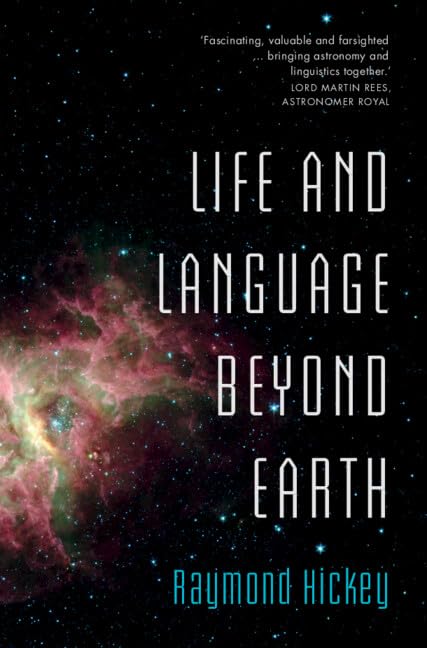
Review
The question of whether extra- terrestrial beings are trying to contact us has been asked before, yet the method of this communication is a fascinating topic of ongoing discussion. The science behind language and linguistics is broad, so widening it to the Universe only adds to the complexity.
Life and Language Beyond Earth invites the reader to delve into the science of languages. Hickey covers a huge range of planetary topics, like astrophysics and astrobiology, blending with a dive into the complexity of language and the idea of an exobeing language.
We begin with the assumption that exobeings share similarities to humans like consciousness and awareness, as well as technological and intellectual capabilities to understand languages,before delving into the spectrum of possible similarities and differences between human and exobeing languages.
The author fantastically presents the effects anatomical differences have on audial capabilities, similarities in sentence and phrase structure, as well as the code-breaking that could be required to decipher an exobeing’s language.
No stone is left unturned. For those unfamiliar with linguistics, the background and context to be able to understand the language of exobeings is covered. It is a rather long read and requires multiple sittings to fully digest all the information given. However, as all the chapters are self-contained, you can dip in and out as you wish.
Most of us have wondered whether there exist intelligent beings elsewhere in the cosmos, but if you’re curious as to how we could possibly hope to communicate with them and have time to spare, this book is for you.
Catherine Regan is a researcher at Mullard Space Science Laboratory.
8. The Planets / Andrew Cohen and Brian Cox, William Collins, 2021, 304 pp., ISBN 9780008280574

Review:
As an irredeemable bibliophile, I’m all too familiar with the temptations of the Folio Society and their gorgeously designed reprints of classic and noteworthy books. Their latest offering is a new edition of Andrew Cohen and Brian Cox’s The Planets, originally a tie-in to Cox’s 2019 BBC TV series of the same name.
Despite some initial surprise at such a book being chosen for the Folio treatment, any misgivings soon fell away. Enclosed in an elegant slipcase, jacket and endpapers, this painstakingly redesigned version is a thing of beauty, eschewing the somewhat jumbled mix of pictures from the original in favour of a carefully curated selection of (mostly photographic) full-colour images chosen by David Rothery of the Open University. The text has been carefully re-typeset and in-text diagrams reduced to two colours to deliver a pleasingly minimalist collector’s item.
In terms of content, meanwhile, The Planets remains a comprehensive and highly readable survey of our current understanding of the Solar System, with a bit of astronomical history thrown in. There are five large chapters – the terrestrial planets are treated in two pairs (Mercury and Venus, Earth and Mars), while Jupiter and Saturn benefit from a chapter each, and a final section looks at the icy worlds of the outer Solar System. The text is approachable throughout and I particularly enjoyed the insights offered in quotes from scientists and researchers past and present. Rothery’s additional images and descriptions help to incorporate some of the key developments since the text was originally written. An expensive treat, maybe, but certainly a worthy gift for a family member or friend (or just for oneself).
Giles Sparrow is an astronomy and space science writer and author.
9. Moonshot: A NASA Astronaut’s Guide to Achieving the Impossible / Mike Massimino, Piatkus, 2023, 224 pp., ISBN 9780349438832

Review:
Stories about astronauts training at NASA or living on the International Space Station, can sometimes feel more like fiction than real life. The day-to-day experience of a NASA employee seems like it would be far removed from our own and it’s difficult to imagine being asked to make decisions at work that directly affect someone’s chance of survival.
What, then, can an astronaut teach us about solving our problems, non-fatal and small in comparison? Quite a bit, it turns out.
Moonshot features 10 life lessons from Mike Massimino: astronaut, actor and professor. After joining NASA as an astronaut candidate in 1996, Massimino flew on two servicing missions to the Hubble Space Telescope, first on Space Shuttle Columbia in 2002, then with Atlantis in 2009.
Some teachings come straight from Massimino, like “one in a million is not zero”, the mantra that kept him going even when he’d been medically disqualified by NASA in 1995. Others are inspired by conversations with a stellar cast, including Alan Bean, the fourth man to walk on the Moon, Jim Lovell, Apollo 13 commander, and John Young, “perhaps, the most accomplished astronaut in history”, according to Massimino.
The stories in this book are of resilience and, often, of failure. I really enjoyed the insights into being an Astronaut Candidate an ‘ASCANS’ – and how it feels to be servicing a billion-dollar piece of kit in bulky spacesuit gloves.
Though the lessons sometimes felt a little lacking in depth (“speak up” is perhaps good advice, but sometimes there can be real risks involved), the book did make me consider my own ‘moonshots’. Who do I need in my support system, my Mission Control? And if, as Massimino writes, “doing one big thing really means getting a thousand little things right along the way”, what small thing can I do today to get me that much closer to my long-term goals? Though I have no intention of travelling into space, I do feel a bit more positive about shooting for the Moon.
Amy Arthur is a science writer and author.
10. A City on Mars / Kelly and Zach Weinersmith, Penguin Press, 2023, 448 pp., ISBN 9781984881724

Review
Four years after starting research on space settlements, the book that husband-and-wife team Zach and Kelly Weinersmith have ended up with is very different to the one they intended to write. Their hopes of learning about our glorious future in safe and peaceful space communities were left dashed, and now it seems like a disastrous idea both for those who go and those left behind.
Fascinating, hilarious and immaculately researched, A City on Mars is a book that sees beyond the techno-utopia to ask if we should really settle in space. The answer? A resounding “Not yet”.
They consider our space exploration history and ask how we would care for the spacefaring, where exactly we would move to, and how we could make it a home. They also talk about the legal arguments, the thorny issue of state creation and the unnerving possibility of space wars.
Bringing some much-needed cynicism to the imagined future of humans in space, the authors compel us to really consider not just the science and technology, but the messy human aspects of space settlement. They point out that space colonies are not going to be the fresh slate that they’re so often painted as, but somewhere that we bring our borders, our baggage and, in all likelihood, our nuclear weapons.
Anyone interested in space exploration will love this, and there simply isn’t another popular science book quite like it. If you need a reminder of quite how far the human race has to go, read this.
Katie Sawers is a science writer.
11. The Earth in Our Hands: Photos from the International Space Station / Thomas Pesquet, Firefly Books Ltd, 2023, 384 pp., ISBN 9780228104445

Review
Imagine trying to take a photograph while floating 400km above your subject and travelling at 28,000km/h! During his second mission to the ISS in 2021, French ESA astronaut Thomas Pesquet took his camera along to document the beauty and diversity of Earth, and to record our impact on the planet and the changes wrought by climate change.
The result is a book of over 200 breathtaking portraits of our home planet, on a journey that takes us from the break of day to the darkness of night.
Each chapter covers a single aspect of the landscape, such as oceans, rivers, clouds, mountains, deserts and cities. The
text is short, focusing on the importance of working together to find ways to combat the damage we are doing to our home. The captions to images are also brief and informative.
But the book’s layout allows the images to take centre stage, and rightly so. I would happily have each page framed and hung on my walls. Some of the images are like abstract art, with sharp lines and geometric shapes that mark human activity. Others are more like impressionist paintings. The range of colours, textures, lighting and detail is dazzling. There are four stunning gatefold images, including one of New York City that is simply magnificent.
With all royalties from the book going to charity, The Earth in Our Hands is a celebration of the beauty of our home planet and a reminder of our responsibility to guard its future.
Jenny Winder is an astronomy writer and broadcaster
12. Dark Star: A New History of the Space Shuttle / Matthew H. Hersch, The MIT Press, 2023, 328 pp., ISBN 9780262546720

Review
Imperfect decisions are often a result of imperfect decision processes. In complicated machines like the Space Shuttle, failures don’t typically arise from unanticipated events but from structural, systemic and human weak-points, as known problems fester and working cultures are permitted to occlude change. When cast with the spectre of random chance, edge-of-the- envelope technologies like the Shuttle are a hair’s breadth away from catastrophe.
For Harvard University technology historian Matthew Hersch, the Shuttle represented a personal ‘space race’ of his own youth, and Dark Star lives up to its subtitle as a ‘new’ history of the spacecraft. Hersch traces its evolution from unrealised World War Two weapons to Cold War plans for hypersonic flying machines, exploring the political climes. that forged a vehicle whose precarious design set it up to fail from the outset.
‘Failure’ is a word infrequently affixed to the Shuttle by historians, many of whom trumpet its accomplishments to counterbalance the tragedies. Hersch pulls no punches in an often scathing assessment of a spacecraft that killed more people than any before or since, whose accidents were neither unpredictable nor unavoidable, and which never fulfilled its pledge to commercialise or democratise space.
Even in the aftermath of disaster and following exposure of the Shuttle’s flaws, it continued to fly. Breakneck work schedules, silencing of dissent, removing rather than augmenting safety systems and a dearth of funding all come under Hersch’s critical gaze in a book as fascinating as it is thought-provoking.
Ben Evans is the author of several books on spaceflight.
Thank you for reading the reviews and recommending the books. Please do visit our library website: Click Here
