Storm In A Tea Cup
U S Kamath
The Professor entered the Director’s office.
“Have a seat,” the Director said.
The Director was browsing through the report, his report.
The office boy placed a cup of tea on the coaster. It was the same tea available in the canteen but served in a big, white cup. He began sipping the tea. In this ambience, the tea tasted a lot better than in the canteen.
Tea and coffee had been priced at 2 rupees in the canteen since long, adding its bit to the ballooning subsidy burden that was eating into the budget for science. He was appointed as the one-man committee to suggest a revised price.
He had attacked the problem in a thoroughly scientific way. It was a multidisciplinary study – the moving average price of coffee powder, tea leaves, sugar and milk relative to their proportions in a cup… in cities comparable in population… fluctuations in the LPG refill prices… prices in the canteen scaled to the average pay of Class IV employees in the institute adjusted for consumer price inflation… effects of the pay commission hikes taking into account the delays in payment of arrears… estimated losses due to spillage, spoilage, over-production… regressions, chi-squares tests, high-order polynomial fits, simulations had been rigorously employed. Thus, the revised calculation had given 4 rupees 42 paise. It was an objective, data-driven report that would have made anyone reach the same conclusion except for the recommendation part. It was here that the Professor had used his subjective, humane side and presented cogent arguments to bring the price down to 4 rupees. This exploration covered sociology, economics, history, tradition and health. He was particularly proud of this section in the report. In his own small way, he had answered a perennial question, “What is the practical use of astrophysics to society?” As an added bonus, his paper, Economic and socio-cultural aspects of tea/coffee-drinking in an astrophysics institute and its effects on scientific productivity, submitted to the Indian Journal of Contemporary Science and Modern Culture, was under review. He smiled to himself.
“Thank you, Professor. This will be very useful,” said the Director.
This was the signal that the meeting was over.
That afternoon, the office order for the revised prices was displayed on the notice boards.
The Professor was in his chair, shivering, staring at the bolted door.
“Professor murdabad ! Union zindabad !” shouted the crowd, banging on the door.
The members of the employees’ union were evidently furious. He was unable to understand why.
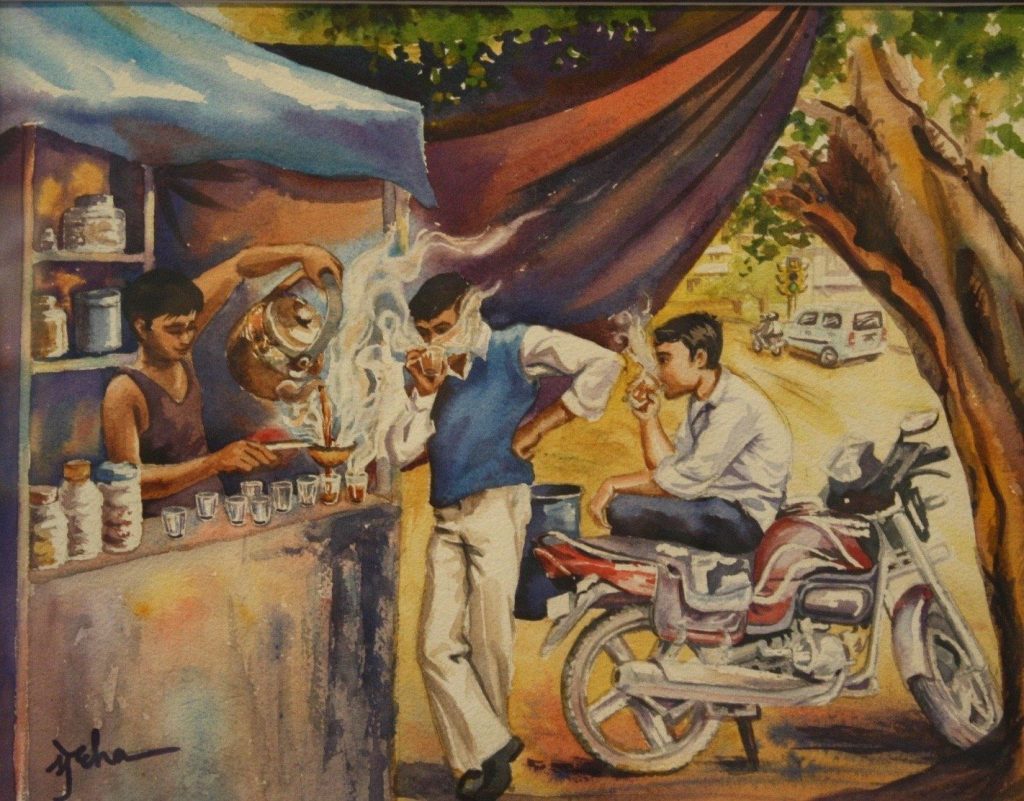
The President and Secretary of the union went to the nearby tea-stall. It was a push-cart perched on a closed drain that doubled as a footpath. The vendor placed two thumb-sized plastic cups of tea and a cigarette on the counter. They lifted the cups gingerly. The tea got over in two sips. The cigarette took longer to finish.
“Ridiculous,” said the President. “Five rupees for canteen tea!”
The Secretary shook his head.
They gave twenty rupees to the vendor and left.
THE END

About the author
U S Kamath is an Associate Professor at the
Indian Institute of Astrophysics.